It's hard to watch, or read, the news these days and not accept the fact that our world is changing. Politically, environmentally, economically and socially. The price of food is rising while the quality slides into uselessness and mega-companies take over more and more control over what we eat, shop for and how it's produced. Wages are either locked, clawed back or stagnating, depending on where you live. There are very few benefits for anyone who works hard, and many days it seems as if it's every man, woman and child for themselves. Indeed, we're seeing a rise of the 'latch-key-kid' again as parents work two and sometimes three jobs to avoid drowning in debt.
My partner has a saying that I've adopted and work to the death.
"Modify and adapt"
We do. I've written here before about making do for ourselves. The way we do laundry has changed, the way we cook, what we cook, how we shop, how we cool our apartment, and on and on. I've written too about doing more for ourselves so that we are not reliant on others, and I've given examples of how we walk the talk, so to speak.
So I was stunned to learn that in some places it's illegal to stockpile, or grow your own food or even keep a few chickens!
Holy Habaneros!
There's a woman in the States, Texas I think, that was sued for replacing her lawn with a vegetable garden. In the end, she won her case, but still...I cannot imagine living in a neighborhood that would presume to tell me how I can live! (One good thing about living in Ontario) Although the region we live in is still trying to decide if they want to allow folks to keep chickens... At least I have the option to grow my own vegetables, herbs and fruit! I don't get enough sun to do that...but I have the option.
So how do we survive these ever changing times? Well, keep our heads down as much as possible. If you stockpile and you're worried that your government or your neighbors are going to knock on your door with either guns or hands out...don't publicize it. I watch a lot of YouTube videos in which this prepper or that will talk about OpSec (operational security) and then make themselves easy to find with a business website found by Google in 3 seconds! If you are concerned about a diminishing market for local beef, then buy your beef locally. Ask at your "local" health food store if they know of any beef producers that are looking for customers. I'm sure you'll be pleasantly surprised. If you worry that Monsanto will come knocking on your door inquiring about your large field of corn, don't advertise that you save your own seed. keep your heads down.
If the price of bread irritates you to no end, as it does me, learn to make your own, either by bread machine or the old way. If the presence of chemicals in your jam worries you, visit your local farmer's market and learn how to preserve the bounty. Tired of paying good money for two Big Macs? Learn how to make burgers at home. You'll save money and might even discover that a burger can have taste. (I'll refrain from going on about growth hormones, antibiotics and other surprises in our meat here, and save that for another post)
We can do more to change our daily lives than what you think, but it does require thought, creativity and commitment.
Change what you do, how you think about the world around you, vote responsibly and pay attention to the news.
Because if we don't pay attention, modify and adapt, we'll wake up one morning to find life as we know it very, very different.
Tuesday, August 30, 2011

Monday, August 22, 2011
Homesteading Factoids

Did you know...?
The Homestead Act was passed in 1862 and signed into law by President Abraham Lincoln. Its purpose was to encourage the settlement of government lands by offering homesteads at a nominal price. Laws had been passed prior to 1862 to support homesteading, but none had been effective.
The Homestead Act granted a citizen land after three steps. He first had to submit an application. If cleared, he had to live on the land for five years and build a dwelling. Finally, he would file for a deed.
On January 1, 1863, Daniel Freeman, a Union Army scout, was scheduled to leave Gage County, Nebraska Territory, to report for duty in St. Louis. At a New Year's Eve party the night before, Freeman met some local Land Office officials and convinced a clerk to open the office shortly after midnight in order to file a land claim. In doing so, Freeman became one of the first to take advantage of the opportunities provided by the Homestead Act.
Six months after the Homestead Act was passed, the Railroad Act was signed, and by May 1869, a transcontinental railroad stretched across the frontier. The new railroads provided easy transportation for homesteaders, and new immigrants were lured westward by railroad companies eager to sell off excess land at inflated prices. The new rail lines provided ready access to manufactured goods and catalog houses like Montgomery Ward offered farm tools, barbed wire, linens, weapons, and even houses delivered via the rails.
In 1936, the Department of the Interior recognized Freeman as the first claimant and established the Homestead National Monument, near a school built in 1872, on his homestead near Beatrice, Nebraska. Today, the monument is administered by the National Park Service, and the site commemorates the changes to the land and the nation brought about by the Homestead Act of 1862. By 1934, over 1.6 million homestead applications were processed and more than 270 million acres—10 percent of all U.S. lands—passed into the hands of individuals. The passage of the Federal Land Policy and Management Act of 1976 repealed the Homestead Act in the 48 contiguous states, but it did grant a ten-year extension on claims in Alaska.
Saturday, August 20, 2011
Changing The Soil Of The Province
As an apartment renter, I'm lucky to live on the ground floor. As a dog owner, I'm a little concerned about the lack of grass around the trees. Now, it's not just our dogs that use the trees, every dog in the neighborhood uses these trees too, we're on the way to a large field. I've been concerned for some time about soil health, and with all all that urine hitting the soil, I've started wondering what I can plant there that might have a fighting chance.
Clover would help rebuild the already horrible soil. Grass seed would be better than nothing, but "regular" grass seedlings might all die back again next summer. Maybe a mulch of wood chips, but then that doesn't help rebuild the soil, it would just cover up the bare spots. So buying a mixed grass seed high in fescues or rye grass would be better I'm thinking. We also have a worn spot that leads from the sidewalk to our patio door, so a small bag of the aforementioned grass seed is needed in a couple of spots. I know that we're not responsible to fix these spots, but I feel guilty because the trail from the sidewalk to our door, and the bald spot in front of our patio door is our fault. Our soil here is nutrient empty and only occasionally sees a worm, so I'm thinking anything I can do to help is going to be a good thing.
I can hear you wondering just how I plan to do this....
I am going to haunt my local hardware store and my favorite local seed company to see what choices I have. I'll open up my compost bucket and see how things are cooking and if it's a t a state that I can use it soon, I'll develop a reseeding plan that includes new soil, compost and grass seed.
I feel a little like Johnny Appleseed...only with soil. Changing the soil of the province, one address at a time.
Clover would help rebuild the already horrible soil. Grass seed would be better than nothing, but "regular" grass seedlings might all die back again next summer. Maybe a mulch of wood chips, but then that doesn't help rebuild the soil, it would just cover up the bare spots. So buying a mixed grass seed high in fescues or rye grass would be better I'm thinking. We also have a worn spot that leads from the sidewalk to our patio door, so a small bag of the aforementioned grass seed is needed in a couple of spots. I know that we're not responsible to fix these spots, but I feel guilty because the trail from the sidewalk to our door, and the bald spot in front of our patio door is our fault. Our soil here is nutrient empty and only occasionally sees a worm, so I'm thinking anything I can do to help is going to be a good thing.
I can hear you wondering just how I plan to do this....
I am going to haunt my local hardware store and my favorite local seed company to see what choices I have. I'll open up my compost bucket and see how things are cooking and if it's a t a state that I can use it soon, I'll develop a reseeding plan that includes new soil, compost and grass seed.
I feel a little like Johnny Appleseed...only with soil. Changing the soil of the province, one address at a time.
Monday, August 15, 2011
Preparing For The Worst While Hoping For The Best
I have a favorite saying, "Better to have it and not need it, then to need it and not have it"
To this end, I suggest tweaking your shopping habits just a little. Now, those of you who know me, know how much I hate to shop, but I've had to come to terms with it lately if I want to see what's out there. There are sales out there (and I shudder to say this) that are actually very worth while. A case of 24 bottles of water for $2, tuna cans for $1.29 or less (a sale for us), or heavy freezer bags for...you see my point. When shopping for canned goods, let one become two, and two become three. In other words, whatever number of , say, canned peas you normally get for your family...let's use a nice round number like 4, get 5 instead. If you find peanut butter on sale, get one, even if you don't need it this week. If your family eats beans, green, yellow, lentil or whatever, get one more than you normally would. This line of thinking can be applied to a few items each week, or month, whenever you do your family's shopping. We recently spotted a large jar of Kraft peanut butter on sale for $2, and we wasted no time in getting one, even though we still had some at home.
So why are we doing this?
Because the economy sucks and grocery prices are rising and grocery stores typically only stock three days worth of food.
Anything can happen. In the winter, blizzards would be an obvious risk. Here, I am the only formal income earner, what if I were to fall off the ladder and break my leg? I'm off work for a few weeks with no income. It'll be nice to have that supply of food.
What if you discovered a friend or family member ran into a tight spot and needed a couple days worth of food to tide them over? If you had extra, you could help them out without taking food out of your kid's mouths.
Recently it occurred to me that we've been buying extra food for us, but not our dogs! Prepping for ourselves is all well and good, but we can't forget the furry members of our family either!
Part of this mindset that will bring a little more peace of mind is skills. Can you make bread? Can you bake sweets? Can you fish and clean what you catch? (I have to work on that last item, it's been years for me) Bread and sweets is a great morale booster. Knowing where and how to fish is a simple way of acquiring meat for your family without going Rambo in the woods chasing down Bambi's mother. I have nothing against hunting, or venison (I adore a good, tender venison steak) but if I am faced with not being able to afford meat for my family, then I'm going fishing. Simply because it's easier, cheaper and less complicated than hunting. Especially because, for now, I still live in a city.
Herbs too will prove to be a morale and health booster.
With the prices of manufactured vitamins these days, for some families, it comes down to 'do we buy a chicken this week, or multi-vitamins that will expire before we finish the bottle?' So learn how to forage for the basics, and learn how to use them.
Dandelion, stinging nettle, willow, rose hip....and if you have a picky eater in the family like we do, learn to get creative. We need vitamins more in the winter, because we tend to eat less fruit, so when you make soup or stew, slip in a dandelion leaf and then take it out before serving. (It makes compost even better for those of you that have composters). Your family will never know that they are eating something filled with vitamins and minerals, but you'll have the peace of mind of knowing they're probably going to be healthier than the family down the street.
These two points are very, very basic, but very, very necessary. Just think about what I've suggested. If I can do these things on my less than shoestring budget, you can too.
Just start small and don't get overwhelmed.
I welcome comments and suggestions
To this end, I suggest tweaking your shopping habits just a little. Now, those of you who know me, know how much I hate to shop, but I've had to come to terms with it lately if I want to see what's out there. There are sales out there (and I shudder to say this) that are actually very worth while. A case of 24 bottles of water for $2, tuna cans for $1.29 or less (a sale for us), or heavy freezer bags for...you see my point. When shopping for canned goods, let one become two, and two become three. In other words, whatever number of , say, canned peas you normally get for your family...let's use a nice round number like 4, get 5 instead. If you find peanut butter on sale, get one, even if you don't need it this week. If your family eats beans, green, yellow, lentil or whatever, get one more than you normally would. This line of thinking can be applied to a few items each week, or month, whenever you do your family's shopping. We recently spotted a large jar of Kraft peanut butter on sale for $2, and we wasted no time in getting one, even though we still had some at home.
So why are we doing this?
Because the economy sucks and grocery prices are rising and grocery stores typically only stock three days worth of food.
Anything can happen. In the winter, blizzards would be an obvious risk. Here, I am the only formal income earner, what if I were to fall off the ladder and break my leg? I'm off work for a few weeks with no income. It'll be nice to have that supply of food.
What if you discovered a friend or family member ran into a tight spot and needed a couple days worth of food to tide them over? If you had extra, you could help them out without taking food out of your kid's mouths.
Recently it occurred to me that we've been buying extra food for us, but not our dogs! Prepping for ourselves is all well and good, but we can't forget the furry members of our family either!
Part of this mindset that will bring a little more peace of mind is skills. Can you make bread? Can you bake sweets? Can you fish and clean what you catch? (I have to work on that last item, it's been years for me) Bread and sweets is a great morale booster. Knowing where and how to fish is a simple way of acquiring meat for your family without going Rambo in the woods chasing down Bambi's mother. I have nothing against hunting, or venison (I adore a good, tender venison steak) but if I am faced with not being able to afford meat for my family, then I'm going fishing. Simply because it's easier, cheaper and less complicated than hunting. Especially because, for now, I still live in a city.
Herbs too will prove to be a morale and health booster.
With the prices of manufactured vitamins these days, for some families, it comes down to 'do we buy a chicken this week, or multi-vitamins that will expire before we finish the bottle?' So learn how to forage for the basics, and learn how to use them.
Dandelion, stinging nettle, willow, rose hip....and if you have a picky eater in the family like we do, learn to get creative. We need vitamins more in the winter, because we tend to eat less fruit, so when you make soup or stew, slip in a dandelion leaf and then take it out before serving. (It makes compost even better for those of you that have composters). Your family will never know that they are eating something filled with vitamins and minerals, but you'll have the peace of mind of knowing they're probably going to be healthier than the family down the street.
These two points are very, very basic, but very, very necessary. Just think about what I've suggested. If I can do these things on my less than shoestring budget, you can too.
Just start small and don't get overwhelmed.
I welcome comments and suggestions
Thursday, August 04, 2011
Now That I Know What I Have To Work With...

First off, let me apologize for a lack of postings; my partner and I went away for a week to see my folks in Northern Ontario. It was to be a kind of working vacation; research, re-con and networking. Let me explain...
We have made plans to move to Northern Ontario in order to help my folks out. This will involve not only help around the house, preserving and baking, but also getting back to a better sense of being self-sufficient. My parents are getting up there in age and health issues seem to be getting the best of them. So they are offering us an out (of the city that is) and we're going to help them out where we can. A part of that is food production, specifically, gardening. We're not in a position to have chickens. My mother had them years ago, but as I've said, health issues and the rising cost of feed phased out the chickens. We will at some point, but likely not in the next 2 years. The gardening will fall to me, no problem there, it's what I enjoy. So while I was up north, I took a good, days-long look at the yard. A decade ago or more, I had a garden there. it was not wonderful, but we grew enough to put some food up. Now though, it is a rutted mass of gravel, weeds, sucker trees and ferns. The surrounding bush is trying very hard to take over the yard, and succeeding with tag alders, wild raspberry canes, goldenrod and a rampant unknown vine. Did I mention it's mostly gravel? So the challenge, as I see it, is a multi-layered one. First, clear back the bush. We, my partner and I, started that this week. I knew in advance that the composter had stopped "cooking", so I took the lid off, not knowing what to expect. The problem had a relatively simple fix; cut the waste into smaller pieces and feed it more regularly. Which was easy while I was there, but I'm not sure the aforementioned health issues are going to allow that composter to be tended as it should, so it may very well stop for now.
I have plans to not only ramp up the composter but also to plant green cover crops, clover and legumes specifically. My folks make clover honey, so the blossoms will be useful to them as well as helping me make the soil a little more fertile. There are some folks nearby who have chickens, so I'm hopeful they'll let me have a few buckets of chicken manure. It's going to be a long time before the soil is dark and crumbly, I know, but I also know that every year will produce better yields. Another thing I'm learning about now is permaculture, which I've blogged about here before. The land has been left to fend for itself, so any positive attention will have benefits. I have lists of what all of us would like to eat, and as I go, I'm planning how to best grow those things in the circumstances I have been given. I know the best place to plant a pumpkin is the compost pile. But since it's still cooking, I can't plant the pumpkin seed there. So I turn to what I do have, and what I can do next year to get pumpkins. I know they won't be the biggest, or sweetest, but they will be more than what we had last year. Which was none. I'd like to grow a variety of tomatoes, peas, beans, peppers, berries, lettuce, carrots, a wide variety of herbs, collards, potatoes, corn, radishes, beets, turnips...and in a couple of years I'd even like to try growing wheat. Now before you tell me I can't, I say, why not? No, I will not be growing enough to avoid buying flour for the entire year. The point of growing things like potatoes and wheat and corn is not to save us money. It is to prove I can, to show the kids where their food comes from, for the good of the land, so that I can build up a store of these things in case the road washes out again, or ever-spiking food prices. (Our milk just went up to $6.00 for a bag of 4 liters!) I would like to grow my own potato sets, my own corn seed and even make a loaf of bread with non bleached wheat. I want to grow as much of our own food as I can for all of those reasons and more. Not the least of which is because I know I can do it. I just have to remember to not expect miracles in one season.
An enjoyable challenge has been trying to decide where to start once the trees are under control. A good neighbor has offered to go over and till the garden for us in the spring, even though we won't be there till the summer is mostly over. I have plans to plant legumes, clover likely. It will grow enough that I can get the green I need, and Mom will have the blossoms for honey. When the end of summer comes, I'll hand till it all under and let it all break down over the winter. This is the quickest way to put some organic matter back, and the nitrogen is sorely needed. I'll be building raised beds so my mother won't have to bend over, sawhorses, cold frames, a large cabinet style solar dehydrator, square foot beds and planning irrigation for the next year. Also in the list of to-do is water collection and storage, even though a river is only minutes away, as is a creek on the other side. So I suppose I'll need to learn how to install gutters, clean out a rain barrel and make another. I also need to learn as much as I can about the well and pump to rectify the crummy water pressure.
Lots to plan and do, but I have to admit, I'm looking forward to the challenge.
Saturday, July 16, 2011
Beating the Cost of Clean Laundry
Anyone who wears clothes will produce laundry. Cleaning laundry is getting expensive, and I hate paying $7 for laundry soap and $2 for dryer sheets and another $3 for softener, but I'm not willing to go naked either! My solution? Offset the cost of doing laundry by making my own laundry soap! Because I am in an apartment, with a laundromat nearby, and have no washing machine of my own, and no clothes line...I'm stuck with what I have, so, let's make the best of it.
The Apartment Prepper offers this recipe:
* 1 bar bath soap such as Ivory or Zote, or anything comparable in your area. (I've used Zote myself, and I was happy with it)
* 1 cup Arm & hammer Washing Soda
* 1 cup borax
* bowl
* plastic container
"Grate the bar of soap with a cheese grater and place it in the bowl. Add the borax and Arm & Hammer Washing Soda. Mix well. Store in a plastic container and label it. Keep it out of children's reach. To use, measure one tablespoon of homemade detergent per load, or two for heavily soiled loads."
We've used a recipe very similar to this (I didn't know about the Apartment Prepper then), and we were happy with it. Lately, I've taken to washing some of our laundry in a non-food grade bucket. Shirts, underwear and socks have all been getting washed at home. In this way, we save laundry funds for those items that are more difficult to wash and wring out by myself, towels, jeans, sheets, quilts and dog blankets. So in goes the homemade laundry detergent, mix well to dissolve. put in the laundry items. I have a plunger that was purchased JUST for laundry, and I'll plunge, twist and mash down the laundry in the bucket, imitating the action of the washing machine. The advantage here is that I use only enough water to cover the clothes, saving on water. Great for those on a well or who have to pay for water. i do this for a while, moving the soapy solution through the clothes, agitating the dirt out until my arms get sore. If certain pieces of clothing needed extra stain fighting power (I love Spray & Wash for this), they've already been treated and they go into the bucket now. More plunging for awhile, then I rinse, repeatedly. Nothing is itchier than undies with soap residue! when the laundry is well rinsed, I wrong it out. Shirts and dish towels and pillowcases go out on the patio over my little accordion style clothes dryer to dry in the little sun that we get. (They smell better for this) and the socks and undies go up in the dryer. Too much work you say? Some days, I would agree, but for the most part, I am getting cleaner laundry, saving and prioritizing my laundry budget AND giving my upper body a workout too!
For those of you who have to use liquid detergent in a laundromat, I offer the following vid from WellnessMama.
Take control of your laundry budget folks!
The Apartment Prepper offers this recipe:
* 1 bar bath soap such as Ivory or Zote, or anything comparable in your area. (I've used Zote myself, and I was happy with it)
* 1 cup Arm & hammer Washing Soda
* 1 cup borax
* bowl
* plastic container
"Grate the bar of soap with a cheese grater and place it in the bowl. Add the borax and Arm & Hammer Washing Soda. Mix well. Store in a plastic container and label it. Keep it out of children's reach. To use, measure one tablespoon of homemade detergent per load, or two for heavily soiled loads."
We've used a recipe very similar to this (I didn't know about the Apartment Prepper then), and we were happy with it. Lately, I've taken to washing some of our laundry in a non-food grade bucket. Shirts, underwear and socks have all been getting washed at home. In this way, we save laundry funds for those items that are more difficult to wash and wring out by myself, towels, jeans, sheets, quilts and dog blankets. So in goes the homemade laundry detergent, mix well to dissolve. put in the laundry items. I have a plunger that was purchased JUST for laundry, and I'll plunge, twist and mash down the laundry in the bucket, imitating the action of the washing machine. The advantage here is that I use only enough water to cover the clothes, saving on water. Great for those on a well or who have to pay for water. i do this for a while, moving the soapy solution through the clothes, agitating the dirt out until my arms get sore. If certain pieces of clothing needed extra stain fighting power (I love Spray & Wash for this), they've already been treated and they go into the bucket now. More plunging for awhile, then I rinse, repeatedly. Nothing is itchier than undies with soap residue! when the laundry is well rinsed, I wrong it out. Shirts and dish towels and pillowcases go out on the patio over my little accordion style clothes dryer to dry in the little sun that we get. (They smell better for this) and the socks and undies go up in the dryer. Too much work you say? Some days, I would agree, but for the most part, I am getting cleaner laundry, saving and prioritizing my laundry budget AND giving my upper body a workout too!
For those of you who have to use liquid detergent in a laundromat, I offer the following vid from WellnessMama.
Take control of your laundry budget folks!
Friday, July 15, 2011
Suburban Prepping...Or Saving a Buck
The Apartment Prepper is the blog perfectly suited to those of us in small apartments who are trying to change our lives. For those of you who may not know, "prepping" is a term that simply means preparing for...well, anything. Financial collapse, hurricane, floods, fires, sudden unemployment, sickness, sudden food or water contamination, power interruption, anything that might change our daily lives in a dramatic way. The Apartment Prepper, gem that she is, has written a wonderful book "The Prepper's Pocket Guide:101 Easy Things You Can Do To Ready Your Home For A Disaster" The book is not a massive tome, so it fits easily in a bag or briefcase for that commute into work. It's broken up into manageable sections and chock full of great ideas that anyone can achieve, so there's no need for 'prepper envy'. I love the idea of storing drinking water in sterilized 2 L pop bottles. Easy and totally do-able. Before you think we've gone all strange on you, think about your own area and how many times you may have been under a boil water advisory. With water stored, this event won't be a big deal. If your city has ever sent around notices warning of work being done on the water mains, it's no biggie if you have drinkable water stored. But, storing water isn't the point of today's post. Suggestion #32 in The Prepper's Pocket Guide is.
Simply, "learn basic cooking skills"
Now, even if you aren't a prepper, hear me out. Basic cooking skills are getting harder to find in most folks. I know people that would burn water, teenagers that have no idea how to cook anything other than a pop tart in a microwave. We're not talking about making a roux, or learning how to make eggs benedict, just ordinary cooking skills. Knowing how to make your own potato chips if the store is closed, or looted, or just didn't get their delivery when YOU want chips. Knowing how to make a burger, from scratch. (Just imagine the envy around the barbeque next company picnic!) For those of us trying to make our income stretch, this is a good idea too. Figure out what a box of Hamburger Helper costs where you live. Now, break that down into basic components. Meat, noodles of some type, flavoring and thickener. All of this is attainable. You can put any kind of meat you want in there, even more than one kind if you want! You can also control the fat content if that's important. Substitute ground turkey for beef, or consider adding sausage to beef if you're looking for added flavor. Herbs are easy, depending on the flavor you're aiming for. An Italian-type dish would have oregano, thyme, perhaps a bit of rosemary, and garlic. A Mexican style dish would have paprika, cilantro, chili or even cumin. Noodles of any type can be purchased in bulk, as can thickeners if you need them. Browse your local yellow pages for a bulk food or dried goods store, you may be happily surprised. The more you can buy in bulk, that you realistically have room for, the more money you save, while being less dependent on someone else to feed you. Do you work all week, or possibly work weird hours and don't feel like cooking when you get home? Have teenagers in the house and slightly concerned about what they eat? Want to insure that your family have something good to feed themselves in case you get ill or have to leave on a business trip? Easy, make meals ahead and freeze them. Let the family know the dishes are there and make sure they understand how to properly warm them (think latch-key kids here or teenagers).
Go to your local library and look for books that teach beginners how to cook. (We love Rachael Ray) Teach yourself how to cook if you don't know how, or teach those teenagers, or tweens, or husbands how to cook by having them help you while you make basic recipes. If you don't have a library card, get one, they're invaluable when you haven't got enough of a budget for entertainment. Scour the web for interesting recipes. What originally got me cooking years ago was a love of Mexican food. I don't do it as often as I used to, but it's on my list of things to pick up again. Perhaps there's a member of your family that is a really good cook? Ask them to teach you how. You may develop an interesting relationship while you learn a skill! Are there cooking classes in your neighborhood? Usually community colleges offer "continued learning" classes for a small fee, and the most popular classes usually revolve around food.
Learning how to cook can provide us with benefits many of us don't even consider. From a prepping point of view, it is security and control. From another view, it helps us save money and provides an opportunity to teach and share with family, or even learn and share.
Thursday, July 14, 2011
Frustration and A Lack of Tomatoes
I confess, I'm getting a little disheartened. While the pepper plant is beginning to flower, and that shows a lot of promise, I am continually thwarted by pea plants that will not flower. The squirrels ate the carrots, and while the tomatoes are growing tall and very green, there are no signs of flowers on them. In contrast, a good friend has tomato plants that she has already gotten fruit off of. I'm sure the difference is the amount of sun. We get hardly any.
So I've been wrestling a lot lately with the question, do I bother trying veggies at all after these are gone? Or do I continue to scour Cambridge for another grow light and try lettuce, peas and carrots inside? Should I get another bag of soil and try sweet potatoes? (I know I can bring those inside once they're started in a bucket)
I want so badly to make this work, but it's hard not to get frustrated. Thing is, there's nothing I can do about the light we get. I think I just need to give myself a slap in the back of the head, a Gibbs-smack as it were and carry on.
More tomorrow, when I have soil and manure. If nothing else, I'll give you an update on the urban bucket compost situation.
Tuesday, July 12, 2011
Homemade Ketchup Video
Running out of time this morning before work, but I wanted to share.
Enjoy and be inspired! Make something for yourselves today!
Thursday, July 07, 2011
First Foraging Success of 2011
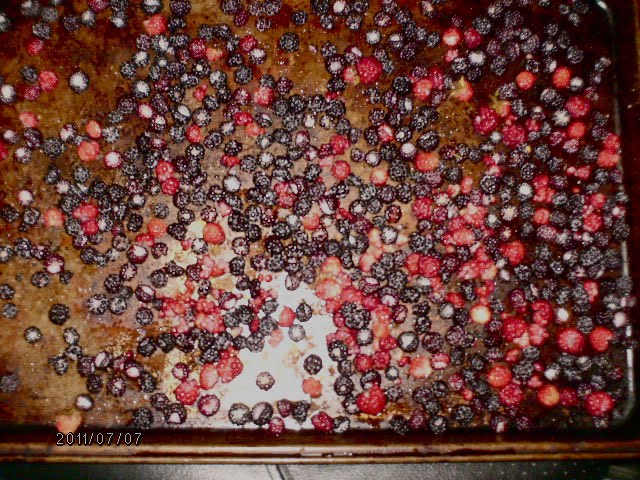
We went for a brief stroll today, just a jaunt before I had to go to work, and came away with all the berries you see to the left, as well as the promise of some very good grapes later in the season!
Tuesday, July 05, 2011
Ten Rules For the Self Sufficient Garden
Yesterday I picked up my second favorite magazine, "BackHome Magazine" and in it is an article that's really got me thinking. Without re-copying it word for word, I'll give you the gist of it and my thoughts.
(By the way, the video I promised has to wait until I can get some soil and time, but it IS coming, I promise)
Rule #1: Plant what you eat.
I'm planning on doing just that, but it has to wait until we get up north, because the only thing growing here with any great success is the herbs. (I doubt we'll get any tomatoes, but the apple tree is going gangbusters!) Our plans include growing apples, radishes, carrots, mesclun, cucumbers, cabbage, rye if I can get it to grow, potatoes, peas, broccoli, onions, zucchini, tomatoes, garlic, chives, peppers, tobacco, rhubarb, sweetgrass and sage, among others.
Rule #2: Plant what you can reliably grow under adverse conditions.
Key phrase here, "what you can reliably grow". well, that remains to be seen considering I'm not sure yet how bad the soil is up there.
Rule #3: Diversify
I think the above list shows a pretty wide diversification.
Rule #4: Preservation
We have extensive plans for preservation. Dehydrating, freezing, canning, powders (more about that later). I'd love a root cellar, but I don't think Mom & Dad would like it much.
Rule #5: Plant more than you think you'll need
With 6 or 7 mouths (depending on whether the Eldest Child moves with us) to feed, exactly how many pounds of potatoes does that work out to? How many tomatoes plants does that translate to? If I'm the only one who likes radishes, should I even bother? What about the aforementioned rye? Surely there must be some kind of chart on the web to answer these questions?
Rule #6: Save your own seed
It's one thing I'm trying to learn about now, while I still have all this time to read. I have at least learned how to save tomato seed successfully. I have visions of jars and envelopes lined up in the freeze, labelled carefully and waiting for soil.
Rule #7: Don't forget the specialty items.
For me, that means tobacco, sweetgrass and sage. These will be grown for spiritual reasons, for gifts and out of respect for the Native teachings we follow.
Rule #8: Stay organic
Because I have a sensitivity to pesticides, organic was my goal all the way along. I think I'm facing poor soil, so I've been learning all I can about green manure crops, compost and egg shells and coffee grounds in the soil, as well as the benefits of biochar. It also means I'll have to learn to distinguish between good bugs and bad. I know what a Colorado Potato Beetle looks like, and the Ladybug. But I've never seen a caterpillar with wasp eggs dotting it's back. Wonder if Chapters bookstore has a book on beneficial bugs?
Rule #9: Don't try to do it all in the first year.
That will be the tough part for me. I already have plans for a solar dehydrator, a solar oven and maybe even a cob oven, a mini greenhouse and a hoop house.
Rule #10: Time is your friend, not your enemy.
It takes time to learn some of the things that I want to learn, it's going to take time to improve that soil, time to build the preserve supply, the seed bank I want, and time to settle into home once more.
It's going to be a long year of waiting.
Saturday, July 02, 2011
Sweet Potatoes, Lettuce and Squirrels. Again.

I was cruising YouTube late last night when I came a cross a video in which a fella had started an indoor garden. Okay, not surprising you say, a lot of folks have done that. What caught my attention though is that he had melons growing. He had already gotten a crop of lettuce, and that got me energized to try again. So after long discussions with the best partner on the planet, I've decided to suck up my frustration and disappointment and try again. So tomorrow I'll be starting two buckets of sweet potatoes, rigged to keep out the squirrels, we'll be starting lettuce inside again, and carrots too.
I am still on the hunt for a grow-bulb to augment the one we already have, and I figure all I need to get is a couple of bags of potting soil and a bag of zoo poo.
I will get my helper to take pictures tomorrow as we go and provide regular updates as the tubers grow.
Thursday, June 30, 2011
Squirrel Thighs With Toasted Pine Nuts!
 There's nothing like a reality check to bring a gardener down.
<----- That is what my carrots were supposed to look like.
There is nothing to show you now, the squirrels ate them. I went to work the day after my last post, pleased with how the plants were growing, and came home to an empty carrot planter.
I have spent the days since grinding my teeth at those little black-furred varmints. And coming up with squirrel dishes. Even at work yesterday I would randomly blurt out recipes to my boss, who knows why I'm resorting to such stress management tools. Squirrel stew, beer battered squirrel with home fried potatoes, squirrel and mushroom pie, squirrel hagis? (That one made even the Scottish boss turn a little green) My favorite was squirrel thighs in a pita with a side of toasted pine nuts. Ironic and fitting.
But now the question is, do I replant, and bring them inside when the weather turns nippy, or give up on carrots?
Sunday, June 26, 2011
How My Breakfast Feeds My Plants

Is it silly to be happy I got 2.5 cups of rainwater the other night?
This morning i have top dressed my tomato plants with a mixture of coffee grounds and crushed eggshells, and then watered it in with rainwater.
For me, this is big. The less water I have to use from the tap, the happier I am. Every ounce, every spoonful of extra TLC I can give my plants, the happier I am. So this one small act this morning made me feel that much closer to my plants, and my food.
The egg shells will boost the calcium in the soil, and help the tomatoes fight off end blossom rot, and the coffee grounds will help bring nitrogen. It seems likely these plants will never see my home-made compost, so any organic additive I can give them is good.
This year is all about learning and experimenting, and every time I do something like this, I feel a little closer to my goal.
Wednesday, June 22, 2011
The First "Wild" Onion of 2011
We visited an abandoned farm today that we've been keeping an eye on, since there's a few edibles there. I went only to check on the state of things after the rain, and in order to see how things were growing I pulled one up. Even though I'm a writer, I find it hard to express how it felt to be standing there with a dirty hand holding a gift from Mother Nature and the property's former owner. It was as if I heard a small voice whispering to my heart, 'There? See? THAT'S what your hands are meant to do!' I swear, I felt a piece of the universe fall into place. Here's the video.
Permaculture, Part 2
Produce No Waste:
By valuing and making use of all the resources available to us, nothing goes to waste.
On the land, on the farm, this is easy to understand. The animals consume and return to the eco-system in the form of their young, fiber, eggs, milk or meat. Along the way, their "waste" is composted and used to improve the soil. The compost enriches the fields and the crops enjoy heavier, healthier yields, to be consumed by both human and animal; once again coming full circle.
But in the city, this concept of "produce no waste" is a little more complex. We recycle. Magazines, newspapers, glass, plastic, office waste (including computers and assorted electronics), we can re-direct our rainwater, garden waste and kitchen trimmings are composted. Even urine can be used! Free nitrogen, anyone? I know of one heroic soul who doesn't use toilet paper. Now THAT'S reducing your waste!
So how do we reduce our waste even more? One idea is to pay attention to packaging. A friend and I had a discussion about this one day. She told me they were putting fewer bags out at the curb. Ever since, I've been wondering how my own family could produce less waste. We drink quite a bit of Coca-Cola, but much less now than we used to. I wonder which packaging harms the environment less, plastic bottles, or cans? Anyone know? We re-use our grocery bags (we have dogs), we use our backpacks when shopping and if we need more room than those provide, we always have 4 or 5 cloth bags with us. I have a few travel mugs to help me be a more responsible coffee drinker. But that begs the question...What do we do with the travel mugs when they are no longer usable? I have cups that leak and need replacing, are they recyclable? (Kudos to Tim Hortons for the .10 cent discount if you come in with any travel mug. Theirs or anyone elses) Even when we sit in, I use china mugs to go easy on the landfills.
I'm proud to say we compost, even though we live in an apartment. I get food grade buckets from Tim Hortons, so it was relatively easy to convert one into a compost tumbler. All one needs to do is drill a few holes in the bucket large enough for air to get in but small enough to keep stuff in and critters out. It's an interesting dance of 3 parts green matter to 1 part brown. Too much green and the compost-in-the-making will stink. Too much brown matter and it won't "cook", as I found out a few weeks ago. For those of you unfamiliar with composting, "green matter" is things like vegetable ends, peelings, cores, coffee grounds, tea bags and even the water the veggies are cooked in. My cold coffee goes in too unless I remember to water the tree with it. "Brown matter" in our neighborhood is the hay bale someone dumped down the road, last year's corn husks and leaves from the path beside the corn field. I make sure the composter lid is on tight and flip the bucket around a few times, roll it around a bit and take a peek to make sure it mixed thoroughly. yes, it's more work than just tossing it all out, but I know I'm giving back to the Earth. In the end, I'll have the greatest soil I've ever had, full of micro-nutrients that will give me happy plants and I'll know that I did my part to NOT clutter up our planet.
So enough from me, now it's your turn. What do you do to minimize waste?
Friday, June 17, 2011
The Mystery of Permaculture, Part 1
 What is this permaculture I keep hearing about?
Permaculture: the development of agriculture ecosystems intended to be sustainable and self sufficient.
To clear it up even more, I dove further.
The ecological processes of plants, animals, their nutrient cycles, waste, climatic factors and weather cycles are all an integrated part of permaculture.
The output of one element becomes the input of another. Chicken manure gets composted to put back onto the land and improve soil. Garden trimmings, vegetable peelings and coffee grounds are also used in the same way. Viewed this way, work is minimized, "waste" is now a resource, productivity and yields increase and our environment is restored.
The first step, say the experts is observation. Wherever you want to put your garden, whether in the ground raised beds or a garden of pots and planters, watch the space for a few months first. A year is recommended. Take note of how much sun that space gets. Six hours or two? Full sun or dappled by a nearby tree? Is it in a breezeway or does it get no air movement at all? All of thee elements and more come into play. Observation also tells us what kind of soil there is in a neglected patch. White clover tells us that the soil lacks nitrogen, while the presence of dandelion, mullein and/or wild strawberries point to an acidic soil. Mullein alone is a good indicator of poor soil fertility. On the other hand, and extremely fertile soil will sprout red clover, chickweed and lamb's quarters.
Diversity is also integral to the permaculture system. Companion planting is beginner friendly, forgiving and easy to learn about. There's a wealth of information on the internet, in library books and at nurseries and even more reputable hardware stores that sell plants.
While you're still in the planning stage, think about the areas you'll be visiting most often and what plants you'll need more frequently. Obviously a balcony or patio garden has a different usage pattern than a yard, but bear with me for a minute longer. Herbs will likely be kept closer to the door. The less you use a plant, or animal, or waterer or any other part of your yard, the further from the door. The yard is segregated into zones to save steps, labour and make maximum use of the space available.
Another element is the capture and storage of energy. This can be demonstrated by the collection of rainwater, re-use of grey water, and even preserving your bounty by canning, freezing, or dehydrating. Those that have root cellars store their fruits and veggies using the earth, although there are folks out there that have turned spare rooms into "root cellars". Now before you tell me that onions and tomatoes are not a form of energy, think about it. Food gives us energy, therefore it IS energy. Solar power, hydro power, wind power,; all of these can be harnessed and stored.
Yet another part of permaculture is the value and use of renewable resources and services. A renewable resource might be a compost bin/bucket/pile. Waste goes in, soil additive comes out. Chickens, goats and rabbits are all renewable services. They all eat trimmings, the chickens love to forage for pests and in return contribute back to the overall system. Before you know it, you have more contribution in the forms of eggs, milk and fiber. They are renewable too! Chicks, kids and kits will grow to be the next generation of yard helpers, or meat, depending on how you feel about that sort of thing.
I've learned a lot more than these few basic principles, but it's too much for one post. Come back tomorrow and we'll talk about waste, integration, design, change and positive impacts.
Saturday, June 04, 2011
Lessons Learned In An Urban Trench

I've learned a few things this past week. (Which is the whole point behind this experiment, to see what I can learn now, before we go up north) So far, the compost in a bucket is going well. It did reach a point where it started to smell, which I sort of expected because I hadn't gotten out to get any dry matter from the woods like I knew I should. So it stopped composting. There was no heat and a gag-worthy smell. No problem, I knew how to fix this. I know a place where someone dumped a bale of hay to rot and I know where there are corn stalks and leaves from last years harvest. So off we went with compost bucket (yes, it has a tight fitting lid) and shovel. We added fallen maple leaves from last year, corn leaves and stalks out of the corn field and a little of the soil too while we scraped and shoveled all that waste matter. I made sure the lid was snapped on securely and rolled it down the road, mixing while we walked. This morning's check revealed far less smell and heat inside the bucket again. It's wet and chilly outside today, so I know that heat in the bucket means the compost is fixing itself. One setback dealt with.
I also learned it's not wise to transplant tomato seedlings. They tend to die. At best, they get shocked and don't grow. Note to anyone trying to grow tomatoes indoors; soak your seed, then plant in whatever container you will be letting your plant spend it's life in. If you must use a smaller container first, I recommend small yoghurt or pudding cups that you can slit with a knife when the seedling has outgrown it. That way, when the seedling needs a bigger pot, you slit the cup open and plant that rootmass in it's new home with as little disturbance to the root hairs as possible. Little disturbance = happier plant. Remember this.
This week taught me that peas are the easiest thing to grow, hands down. Those peas up there to the left have been the most tolerant and forgiving of any seed I have started here. The tallest is 5" high, and obviously the oldest. All are a good shade of green, the leaves feel firm and the stalks are strong. The only thing more robust than the peas is the parsley and the basil. I will not be transplanting the peas. It was always my intention to let them live their lives in that container. See how tall they grow, see what kind of pods they'd produce, if any, and just generally see how they did. With any luck we'll get enough peas to eat, and maybe even some to put up.
Another lesson to note; it is possible to dehydrate pineapple slices in an electric dehydrator with holes in the trays. I cut pieces of wax paper and rested the pineapple slices on them. For this experiment, I used a can of pineapple slices. I'll explain why in a moment. I did not turn the slices when they began to dry, and so three or four stuck to the wax paper. They were a write-off. So, if you use wax paper under the pineapple, discard after the pineapple is no longer drippy. While I was on a dehydrating roll, I also sliced up two Fuji apples. I let the slices rest in the can of pineapple juice for about thirty seconds, to prevent the apple from going brown in the dehydrator. I took the apple slices out, let the juice drip back into the can and plopped them into the dehydrator as well. So far, they are doing well. Still soft, but they are progressing as the books say they should and aren't brown. So far, so good.
That's the update from our trenches, where I'm fighting to learn all I can now, before I get to our micro-farm up north. I know urban farming is possible, hundreds are doing it all over the world. But right here, right now, in our dark apartment; I'm still learning.
Thursday, June 02, 2011
Apples Here, Apples There...

There is a great deal to be said for basic food. A loaf of bread, still warm from the oven, a hearty, steaming casserole, a crisp, crunchy apple....mmmm, I haven't had breakfast yet and already I'm hungry. Not long ago we got a pretty good deal on 8 pounds of Fuji Apples. For some reason, the boys aren't keen on just biting down on one like I am, so we make more apple desserts. For many years, the apples we were buying from the grocery store would make my throat close. So I tried washing the fruit better, we tried fruit washes, we tried different types from different countries. We bought organic, and then we found a local grower. At an outdoor market one morning, I was encouraged to try a bite of an apple wedge. Tentatively, I bit. And waited. Because the reaction would normally happen pretty quickly, I knew fairly soon that the apple was going to be fine. To say I was happy would be an understatement. Ever since then, we have been careful not to get apples from too far away, and my throat doesn't close after one bite. I can only guess that I was having a reaction to a pesticide. So, when the chance came to buy 8 pounds of apples to benefit a school, my question was "Where are these grown?"
I was relieved to find out they're local. So now we have a kazillion apples. They're good for us, with vitamin C, fiber, natural sugars....all kinds of crunchy goodness. The fuji was originally developed in Japan back in 1952 and brought to this side of the ocean in the '80's. Pretty cool!
But now, what to do with them?
This weekend, I want to dehydrate as many as I can. I'm also looking into making fruit leather (also known as fruit roll-ups), apple cobbler sounds yummy too. I would make pie if I could make a decent pie crust from scratch, but it's never been a skill of mine. Apple butter sounds yummy too, as does slow baked apple wedges.
SLOW BAKED APPLE WEDGES
3/4 cup of liquid honey
1/2 cup of water
3 tbsp lemon juice
1/8 ground nutmeg
8 large apple wedges, peeled and cut into wedges
1. Combine honey, water, lemon juice and nutmeg in a large bowl. Add apple wedges, stirring to coat well.
2. Spread apples in a 10" X 15" pan, pouring any remaining liquid over the top of the apples. Cover with foil and bake at 300 degrees for 45 minutes or until apples are soft. Remove foil and bake again until apples are golden and most of the liquid has evaporated, about 75 minutes. Gently turn apples once or twice during baking.
3. Pack into clean jars or plastic containers, cover with tight fitting lids. Store in refrigerator up to 1 week or freeze for longer storage.
Wednesday, June 01, 2011
Do Not Go Quietly Into The Night
 I have certain blogs I like to read every day, as I'm sure we all do. A lot of people are talking about food this week. Food shortage, the price of oil and extreme weather are all hot topics, and they're all related, and they could individually or collectively affect the price of your day. A loaf of bread, your daily two cups of coffee and bagel, dinner, the bag of cookies or that apple you have stashed.... all of it can be affected by a two-cent jump in the price of crude oil and a bad weather event between the produce shipper and your favorite grocery store.
I'm not one of these "the world is over" types, but the writing is on the wall, we can't ignore it anymore. So what do we do? What do those of us in the city do if we have very little or no yard? We get creative. We get tough. We become survivors.
This is my call to action.
Start paying attention to competing grocery prices. Easier said than done, I know, I hate grocery shopping. Start saving those coupons, scour the sale papers, find them online for your local grocery stores. Buy dry goods differently. Buy a little more than you normally would if you can. Try and aim for one now, one to save. This applies to a great deal of your list. Can you get two loaves of bread this week? One for now, one to freeze. Instead of getting three apples, get five. Can you afford an extra tin of tuna? You get the idea.
Then, learn how to store these things wisely. Get a system together that will allow you to keep track of when you bought them and when they'll expire. I work in retail, so I'm keenly familiar with this system. Keep track of the things you buy for backup. Have a place you can store them so the kids won't run through your stash of animal crackers, let's say. (Mine love those packets of dried noodles and would happily eat 4 a day, per person if we let them. This calls for creative stashing)
Not everyone can afford to do this all the time. I certainly can't. We buy an extra jar of peanut butter here, an extra can of tuna there, an extra box of dog treats on pay week, and we store them in a large plastic tote bin. It might not look like we have much, but that stash has proven to be a small saving grace during weeks we hit a leaner-than-normal stretch. We do a little at a time, as we can.
Start teaching yourself what you need to know to make your own food. We've been saving a bit of money lately, and eating a little better by making more of our own bread. Not all the time. We still have lives and I still have a full-time job. But instead of buying a loaf of bread six times a week, I'd say we're down to maybe three. We have a bread maker that's seeing a lot of action these days, and the bread we're eating is better for us than that white, over-processed stuff with ingredients I can't pronounce. The bread we make still has white flour in it, I'm outvoted there, but what we're making has whole wheat in it too, and less sugar and more honey, which is healthy in so many ways it needs its own post. So we're buying less and eating healthier.
Get creative with dry goods food storage. I know of one person that has saved large pop bottles and stores their pasta, dried beans, dried soup powder, drink crystals and cereals in those bottles. Because they have next to no cupboard space, they store those bottles in a suitcase, under their bed! Now THAT'S creative!
I am lucky enough to have made a connection with a Tim Horton's coffee shop next to my store. They save me the buckets the frosting comes in and I have a variety of buckets in a range of shapes and sizes. Now we have a bucket for flour, one for sugar, a small, rolling compost bucket.... you get the idea.
As you may know, we're trying to grow our own veggies and herbs here in our apartment. We're teaching ourselves how to grow responsibly with our experiments in green manure crops, small scale composting and a soon-to-be attempted permanent indoor garden. It's not always successful, but we keep trying. Why?
Because I refuse to roll over and give up. I hear about the food shortage in Canada and it makes me angry. We shouldn't be short of food in a country that is supposed to be one of the world's greatest places to live. We have kids, so we can't just give up. We have brains and hands and we can still do something about it so that we do NOT go quietly into the night, hungry and weak.
I am not hungry and weak, I can still take even small steps to feed my family.
You can feed yours too.
Do not go quietly into the night.
Learn.
Do something.
Stand up and fight for your next meal!
Subscribe to:
Posts (Atom)