Saturday, October 22, 2011

The Anari Effect, Chap One, continued

The preceding part can be found here...
and now for the continuation...

A knock sounded at her door. “Come.”

“I had to mug a couple of techs for their brownies, but they’ll live.” Teresa smiled.

Dakota took a heavily laden tray over to the credenza and motioned to the sofa. She poured two cups of coffee and took one to her assistant, then settled at the opposite end of the sofa with one leg tucked under her.

“I’m not one of these people that can’t get their own coffee, so don’t expect me to ask you for every little thing I need. I’m hoping that I can rely on you to truly assist me, not do my work for me.”

“Understood.”

“I do have a few questions though. First, I know someone held this office before me; why are they no longer here and I am?”

Teresa took a sip of coffee as she pondered how best to answer the question. “Simply put, stress forced him to take another, less demanding job.”

“He burned out?”

“Pretty much. Wells Corp. management looks at the people who work on this floor to lead the company on the right path for the future. Product design and sustainability have kept this company going for ten years, and we’ve gained a very good reputation among the public. We are as much a household name as GE has been, or Panasonic, or any other name that holds the public’s attention. Now, we want to be the one people think of when they reach for an item that won’t need replacement next year. Your predecessor ran out of ideas. He started drinking heavily, then self-medicating, and his sporadic ideas just seemed to…dry up.”

“How long have you been here?”

“Nine years. I started sorting mail for the techies, and just moved up through departments until I landed here last year.”

“So you must have a good idea of how things work. Do the assistants do more work here than they get recognized for, like most other places?”

Teresa watched Dakota drink from her cup as she replied. “No, we get fair recognition for all the work we do here. The benefits improve as one moves through the organization, and I’m very happy with the pay scale, the perks and my job in general. What about you? What brought you here?”

“My last job was a designer, but it was fraught with inter-office politics and the good old boys club. I would design something that I thought would be hot on the market, but the item that eventually got developed was so down-graded and changed, that by the time it hit shelves, it was hardly my design anymore. After a while, I dreaded going into the office and found reasons to work at home. When I woke up one day, dreading a meeting I had, I knew it was time for a change. Waking up this morning, in a house that talked back was a change.”

Teresa laughed out loud. “I’ll bet. That’s an interesting quote on the wall. Buddha, wasn’t it?”

“I’m impressed. Not many know that without peering at the bottom of the plaque.”

“You’ll find I’m full of surprises, Miss Anari.”

“Oh please, if we’re going to be working together, we’ll need to get past the formalities. Call me Dakota. Tell you what, you tell me something that no one here at work knows, and I’ll do the same. That should break the ice.”

Her assistant smiled, and took a deep drink of her coffee. “All right, I hold a masters degree in critical thinking, one of my strengths is problem solving, I own a Honda Shadow and my biggest thrill is to go screaming down a straight highway doing 120. Your turn.”

Dakota smiled. “Ok, I failed science three times in grade twelve, I prefer drinking from a mug over china, and I have a fear of heights.”

A devilish grin began to spread on Teresa’s face, but whatever she may have wanted to say was cut short by another knock on the door.

“Come in.”

The door swung open and a tall man that Dakota recognized as the president of the company stepped in.


“Dakota, you remember Mr. Wells, don’t you?” Teresa said.

Dakota nodded and shook his hand.

“I have some paperwork that needs signatures, so I’ll excuse myself. Good to see you again, Mr. Wells.”

The company president strolled to the credenza and poured himself a glass of water, then occupied the seat that Teresa had been sitting in. “Settling in alright, Miss Anari?”

“Just fine so far, sir, thank you.”

“I realize that we’ve been somewhat vague with you to this point, and I want to assure you that it has been necessary. In your second interview, you may remember, I told you that Wells Corp. designs and creates cutting edge, domestic technology; much like the so-called “smart house” we’ve provided for you.” Stanton paused to sip from his water glass. “But that doesn’t begin to cover what we do. Your house is one of a kind right now, and I admit that we are using you as a test subject in a way.”

Dakota’s eyes widened, but she held her tongue.

“We wanted the opinion and expertise of someone in your field to give us educated feedback on the house, and its programming. I hope you don’t mind.”

“Once I taught it what hot water was this morning, it was fine, but I’m sure there are a lot of…things about the house that I have yet to discover. If I may ask a question?”

Stanton nodded.

“You were never very clear about your expectations of me with Wells Corp.” Dakota observed.

“We’re looking at you for our ideas for the future. Our future products that will allow our domestic customers to live in ease and comfort.”

“So you said in the interviews, but if you could be a little clearer?”

“Your former employer told me you would be full of questions. Very well, we need someone who can come up with the ideas for products that will put us one step ahead of the competition and give our customers a reason to continue to buy from us ten, fifteen or even twenty years down the road. Your idea for the voice activated reading tutor, for example.”

Dakota could hardly believe what she was hearing.

“Your former supervisor, Peter Engle, spoke very highly of your creativity, your ambition and your drive. That’s the kind of person we need here. Someone who is not stuck in the past and can see beyond their own needs, someone who knows what is going to be wanted and needed by the public, and someone who can work with people. You answer to me, the vice-president, and to the Board of Directors. Have you been shown around?”

“I have.”

“Good. I have a meeting to get to, but feel free to knock on my door any time. If you have any questions by the end of the day, just let me know.” Stanton stood up, adjusted his tie and shook Dakota’s hand. “Welcome aboard, Miss Anari.”


Dakota stayed on the sofa, more than a little amazed at her day so far. A knock on the door shook her from her thoughts.

“Come.”

Teresa came into the office and smiled. “Still trying to absorb it all?”

“Is it that obvious?”

“Afraid so. But don’t worry, it’ll sink in soon. There are some plans you need to go over and approve.”

Dakota went and sat on the corner of her desk. “Anything else?”

“You have a meeting with your advisors at 1 this afternoon, a meeting with the techs at two thirty, and more paperwork after that, I’m afraid. But look at this way, this is the easy day.” Teresa smiled.

“Great.” Dakota almost groaned, but she couldn’t wait to get to work.

Teresa handed over the files and plans Dakota needed and then turned to leave. “I’ll be back with a carafe of coffee in just a few minutes.”

After the third attempt to decipher the tech’s notes in the margin an hour later, Dakota finally understood that most of the prototype’s wiring was needless. She hit the intercom on the phone “Teresa, where would I find a Mr. Berck in the tech department?”

“I can track him down on the phone for you.”

“That would be great, thank you.”

A few minutes later, the intercom buzzed again. “Miss Anari, Mr. Berck on line one.”

Dakota grinned at the phone. “I thought I asked you to call me by my first name? Thank you, Teresa.” Dakota was all business as she punched the button for line one. “Mr. Berck, Dakota Anari here.”

“Yes, Miss Anari, how can I help you? I don’t often get calls from the head of development.”

“I have a question about the interactive clock prototype. It seems a lot of these wires aren’t needed.”

“That’s true. My notes recommended eliminating most of them, and installing a small battery operated fan, as a cooling unit for the computer chips. If we ignore the heat that those chips and circuits are going to put out, we’ll have product burn-out in as little as two years.”

“I see. If we follow your recommendations, how long do you think it will last?”

“It could last up to ten years with proper care, I believe.”

“Thank you, Mr. Berck, I appreciate your candour.”

Dakota opened a new message window in the company email program, and wrote her first email to Stanton.

‘With regards to the prototype interactive clock currently in development, I believe this may be something worth pursuing. I have spoken to the lead tech, and we agree on a significant change that could increase the product’s lifetime by a number of years. This could be a solid sales tool to market the clock. I will meet with my team later this afternoon, and give you a further update thereafter.’


Dakota then opened up a link to the internet, went to her favourite search engine and began to type.

An hour later, a knock on her door jolted her from her reading.

“Come.”

“Dakota? I’ve just come back from the dining room and I brought you some hot chocolate.”

“Thanks, Teresa. I wanted to ask you something. Have a seat.”

Teresa handed Dakota her mug and settled on the leather sofa.

“What do you know about nanotechnology?”

“Wow, you don’t ask easy questions, do you?” Teresa ran a hand through her short hair and thought for a minute. “I know that nanotechnology is a science dealing with the control of atoms and molecules. I’ve heard the term bandied about a lot in the last two years, but it’s still very much a mystery to most people. Why do you ask?”

“This clock we’re creating…the prototype is too large and heavy for my liking and after my conversation with Mr. Berck, I got to thinking about the possible inclusion of nanotechnology to see if we could replace some of those wires. It turns out that it may be possible, in theory at least, to eliminate some of them by adding Fullerenes to the liquid crystals.”

“What will that do, and what’s a Fullerene?”

“I’m hoping that it will eliminate the need for some of the wires leading to the display screens. A Fullerene is a molecule comprised of carbon, and they can be shaped like spheres, ellipsoids, or tubes. Not too long ago Fullerenes were thought to have potential in binding antibiotics to resistant bacteria, or even deliver cancer-treating drugs in a more reliable way. Unfortunately, a study showed that largemouth bass suffered brain cell damage and liver inflammation when subjected to water with fullerenes present at 0.5 parts per million. After that, the Fullerenes were deemed as not being stable enough for organic purposes. But I’m wondering if we can use their non-organic potential in our work.”

“What are you thinking?”

“If there is a way that we can use nanotechnology to program functions on that clock, without the heat of a computer processor, no matter how small, then we can add reliability and life expectancy to our product, right?”

Teresa nodded.

“If we can go one step further and add a day planner feature to that clock, allowing the consumer to have even more control over their day, then the product is even more desirable. Correct?”

“You’d think so, yes. But if I may play devil’s advocate for a moment…”

Dakota nodded.

“What would the cost of this technology be to the end user?”

Dakota chuckled. “Good question. I’m not even sure if it’s possible. I’m meeting with the brainiacs in just a few minutes. I’ll ask them. Assuming of course that I can find …”

“The board room? I can show you the way whenever you’re ready.”

Dakota retrieved a notebook from her desk, as well as the plans and notes for the prototype clock. “I’m ready.”


“Gentlemen, gentlemen..” Dakota held a hand up.

The shouting continued and rose in pitch.

“It’s not possible!”

“Who the hell are you to tell me that my design is over-inflated?”

“You’re not creating any repeat market for the clock like this!”

“You have no right changing a design that took us months…”

“I want to see your credentials!”

“THAT’S ENOUGH!” Dakota slammed her leather bound notebook on the table, and there was a crack mightier than any thunderclap

The room was as silent as an empty church.

“You want to see my credentials? Fine! I’ll email each of you a copy!” A vein throbbed at her right temple as she pinned one of the developers with a murderous glare. “You want to know what gives me the right to change your design, I’ll tell you. The fact that I, not you, am now head of this department! Mr. Wells hired ME to head it because he wanted fresh ideas, not someone who was going to offer up excuses why something couldn’t be done! Now get your heads out of your asses and give me REAL obstacles to my idea or get out!”

Dakota waited with her hands on her hips in stony silence, staring down each man in turn until she came to one in particular. “Judging by that look on your face, I’d say you have a problem with me. Spit it out.”

“I’m not answering to you.”

“You do and you will, Mr. Tukis.”

“I’ve never worked under a woman, and certainly not one of your kind, and I refuse to start now.”

“My kind? What kind would that be?”

“I won’t work under a lesbian.” He spat the words out.

Dakota was shocked for only a moment. “Trust me, Mr. Tukis, the last place I’d expect to see you is under a woman. I’d be surprised if any woman, no matter what her orientation, would have as hateful a creature as you.” She waited for her words to sink in before continuing in a quieter voice. “What I do expect to see however, is you walking out that door.” Dakota pressed a button on the phone. “Teresa, call Len and have him come to the board room, please.”

“You can’t do that to me!” Tukis was on his feet in outrage.

“I can and I will! This is supposed to be a team environment, and you obviously have no interest in being part of a team.”

“I have been here since the company’s inception; I’ll go to the top! Hell! I’ll have your job!”

The door opened and two security guards entered the room. “You asked for me, Miss Anari?” Len said.

“Thank you for coming, Len. Mr. Tukis here will be leaving Wells Corp immeadiately. He is not to return unless the invitation comes straight from Mr. Wells or myself. I will have someone pack his belongings.”

Len and his associate stood by Tukis’ chair. The developer headed for the door, but turned at the last moment. “I’ll have your job for this!” he repeated.

“The dark ages are over, Mr. Tukis. The good old-boys-club is gone, and if the president of this company says you’ll answer to a lesbian, than that’s what you’ll do. But I don’t have to work with anyone as narrow-minded, sexist and ignorant as you are. You think you’ll have my job?” Dakota smiled at her adversary. “I don’t think so. In fact, I think you’ll find your credentials antiquated, your theories out of date and your morals no longer the norm. Good luck finding any job, let alone getting mine.”


When the door had closed behind the men, Dakota turned back to the others and said, “Does anyone else have a problem answering to me?”

No one spoke up.

“Good. Now, I was hoping that I might get some productive brainstorming going here. All of you have experience that I do not, so what I’m looking for are reasons why my idea cannot work.”

One man who had not made a sound through the ruckus cleared his throat.

“Mr. Holland, isn’t it?”

“Miss Anari, I must admit, I’m a little surprised.”

“By what, exactly? My credentials, my sex, or my orientation?”

“That you would seize the reins so firmly and so quickly; actually. I’m also a little surprised that you would ask us to point out obstacles.”

“Well, Mr. Holland, I’m a big believer in getting problems out of the way quickly; both with personnel and from a design perspective. Do you have any thoughts on the prototype?”

“I do, actually. If I may borrow the schematics…”

When they all emerged three hours later, Dakota returned to her office famished and tired. Teresa’s desk was unoccupied, but in the middle of Dakota’s desk was a brownie covered in warm fudge icing, and a note. ‘Congratulations, you sounded great.’


Thursday, October 20, 2011

Live Large


I'm going to take a small break from The Anari Effect and survival for just a bit here.
I have recently accepted a facet of myself I was previously in denial of. I do not want to live quietly.
Not really.
I want to live in the bush, yes, but I am not a quiet person; not really. Some of you may know I have knit on and off for some time now and my knitting has really gathered steam over the past few months. I feel differently about it now. I want color, I want form, I want something BACK from my knitting, whether that is a nice piece to look at with cables, or some piece of nature in the knitting, or fabulous swatches of color...something that makes someone sit up and take notice. Even twenty hats knitted for the homeless.
Something that makes an impact.

So how does this relate to everything else?
I find now that I am over forty, I have really started to discover who I am, who I WANT to be. This blog has helped me discover that. What I want to write about, what moves me, what makes me gnash my teeth, what inspires me.
All of you have been a large part of that. You have been my sounding board, my guides.

So now I offer you the following advice:
Live large, don't settle for something you don't deserve. Make a splash, do not meld quietly into the background, stand up for something that you passionately believe in and fight for what is right!
Do good. Find a cause and do some good; no matter if it is knitting for the homeless, volunteering at an animal shelter or elder's residence, fundraising for a debilitating disease....SOMETHING! Make a difference for good and you will always have something to feel good about.
Watch sunsets or sunrises, or both. OFTEN. When we see the beauty in the world around us, we will not waste the time given to us.

Finally, LOVE.
Love the good people in your life, love a pet, love something or someone so intensely that your heart feels it might break. Live in the moment, but learn to plan.
LIVE LARGE.

Saturday, October 15, 2011

The Anari Effect, Chap One

As I promised, here's some more of The Anari Effect

The Anari Effect, Chapter One

Dakota held her new I.D security card up to the glass so the security guard could scrutinize it carefully, then nodded and opened the door for her. “Good morning, Miss Anari. First day, right?”

“Yes it is thank you.” Dakota smiled.

“My name is Len; I’ll be letting you in every morning and escorting you to the executive level.”

“Do you do that for everyone?”

“No M’am, just the top ranking folks such as yourself.”

“I’ll bet you’re a very good secret keeper.”

Len only smiled and nodded as he pushed the elevator button.

The elevator was very quiet. There was none of the tinny “muzack” that Dakota expected. Instead dark wood, well-polished brass, wine coloured carpeting and sound proofing weave surrounded her. Dakota glanced at her silent companion, unsure if she should ask the question on the tip of her tongue. Len was a massive and slightly imposing man. He stood well over six feet tall, kept his beard trimmed and his long hair pulled back. He could have checked his reflection in his shoes; they were so polished.

“Something on your mind, Miss Anari?”

“I was just wondering…this elevator, this building…it’s not at all what I expected. Only three buttons?” Dakota pointed to the control panel.

“This is the executive elevator. There are only three buttons because everything you’ll need within this building is on those three floors.” Len pointed at the panel before continuing. “I’m sure your assistant will be able to answer any more questions.”

Dakota nodded. When she had been offered the position, she was told she would be getting an assistant.

“Here we are.” Len said as the elevator came to a stop. The doors opened and they stepped into a hallway that mirrored the environment of the elevator.

“Miss Anari? I’m your assistant, Teresa Cummings. She was a slight woman with dancing eyes and an enigmatic smile. Dakota shook her hand and found herself impressed by the confident grip she got in return.

Len took his leave of the women and Dakota turned to her assistant.


“I’ll show you around and give you a tour. Teresa turned and Dakota followed full of curiosity. “There are three washrooms for the women on this floor, and the same for the men. Here is your key.” Dakota nodded and pocketed the silver key.

“This branch of the hallway leads to the executive dining room, but if you’d rather eat in the privacy of your office, they will deliver.”

“Executive room service?”

Teresa chuckled. “Something like that I suppose.” As they turned a corner, she continued. “Down this arm of the corridor are the upper management offices, and down here is a smaller coffee room that most of the secretaries and some of the other assistants hang out and chat when we can.”

“And my office is…?”

“Right down here.” Teresa led the way down a dark-panelled and carpeted corridor that looked like every other one she had shown Dakota.

“It’s all very maze-like.” Dakota commented.

“I’m sure it will all become familiar to you as time goes on. This is your office.” They were standing in front of a dark door with only a single brass plaque on it that read, ‘D. Anari, Director of Development & Sustainability’.

The outer office looked just like the rest of the floor, but there was low music coming from hidden speakers.

“Your office, right?”

“I’ve always liked to think of myself as front-line kind of person.” Teresa smiled. “Your office is through that door.”

“Do we have time for a chat?” Dakota asked.

“How do you feel about chocolate?”

“I’ve always felt it should be a food group.”

“I’ll be back in a jiffy with coffee and chocolate, then.”


Dakota waited until she was alone before she turned the knob to her office. She was a little alarmed to see the contents of her previous office, until she recalled the agreement that Wells. Corp would move her belongings. Dakota was immensely pleased to see two large windows that allowed the sun to pour in and spread sunbeams on her tiger-maple desk. Inherited from her grandfather, the massive desk had helped her feel at home, no matter where she worked. Her possessions were all here. Her gel stress ball, the aquarium that housed her Siamese fighting fish, separated by a pane of glass, her little green dragon that she jokingly referred to as her computer guardian sat atop the monitor; even her motivational plaque on the wall that read, ‘With our thoughts, we make the world.’ The only items she did not recognize was a large, tan coloured leather sofa tucked away against one wall, and her brand new computer, which the little green dragon watched over.

Dakota closed her eyes, stood in the sunbeam and breathed in the scent of her new office. When she opened her eyes again, she was smiling.


More to come in a couple of days!

Wednesday, October 12, 2011

The Anari Effect

I feel like doing something different today, something to continue the creative streak I'm on, something to inspire me even further.
So, in that spirit I offer you...

The Anari Effect

Prologue…

“Dakota Mackenzie Anari, it is time to rise.”

A lump beneath the covers groaned in response.

“That is not an adequate reply. It is time to rise.”

“Go frag yourself.”

“I am unable to find meaning for the word frag. Please provide definition.” The female voice requested.

“Drop it. I’m up.” The covers flipped back and a naked woman sat up and squinted at the light coming in her window. “Who the hell programmed you to be such a nag?”

“Unknown.”

“Figures. What time is it?”

“It is currently six-thirty in the morning.”

“Great, one of the first smart homes in this city, and it’s an early riser. Dakota mumbled to herself as she padded into the bathroom. The shower turned on by itself, and she jumped back. “What the hell?”

“You wish to bathe, correct?”

“Yeah, but how did you know?”

“It is part of my programming.”

Dakota shook her head and stepped into the shower. “YOW! Does your programming tell you about hot water?!”

“Adjusting water temperature…will ten degrees warmer be sufficient?”

“Make it fifteen and I’ll be happier.” Dakota replied. Once the water warmed up, she asked, “Can you self-program this temperature for all my showers?”

“Temperature set.” The house replied.


After her shower, Dakota dressed and strolled into the kitchen. One glance around the room made her aware she hadn’t asked any questions when she saw the house originally.

“If I were a coffee maker, where would I be?” she mumbled as she opened the cupboards.

A small screen above the sink flickered to life and a woman’s visage appeared. She had short dark hair; a heart shaped face and wore a serious expression.

“Who are you?” Dakota asked her.

“I am the representation of this home’s computer, provided to you so that you might be more comfortable here.”

“A hologram?”

“That is correct.”

“Good enough. Now if you could just point out the coffee maker…”

“What is your flavour preference?”

“I take my coffee black, if that’s what you mean.”

The woman on the screen glanced to her left, and Dakota’s eyes followed. She was only slightly surprised to see a small panel slide up into the wall and a steaming mug waiting inside an alcove. It smelled good, and tasted even better.

With coffee in hand, Dakota toured the house to get a better look than she had the night before. A driver had picked her up from the airport, and gave her the key to the house, but had been very vague on just what the house could do. Dakota had only taken the time to lock up, strip and get into bed. Her preliminary information had revealed the house had interactive speech capabilities, but the pamphlet had only hinted at interactive gems yet to be discovered. Dakota assumed her new employers expected her to discover the home’s capabilities on her own.


The kitchen was spartan at first glance. The counters were a pseudo-marble, the sink a standard chrome, as was the stove and refrigerator. “I remember reading the manufacturer’s information for this house, but if I’m supposed to interact with you, what do I call you?”

“I have been designated as HnnA 36.”

“Hmm. You are familiar with my name, and the designer didn’t give you a human designation, so I’m going to call you Hanna.”

“That is acceptable.”

“So tell me, Hanna, what do I need to know about you?”

“Please specify the request.”

Dakota sighed heavily. “Very well, who designed you?”

A small screen in the dining room wall flickered to life, and Hanna’s hologram appeared. “I was designed by Wellington Coriolis and built by his private construction company. I am the only one of my kind recorded. I have a level of intelligence and programming that is unique to smart homes. I am … singular.”

“Almost sounds like bragging, Hanna.” Dakota smiled. “What can I expect?”

A moment after the question had been asked, one of the windows darkened and showed a picture, which then morphed into a local newscast.

“Impressive.”

The picture morphed again, but this time into a bar graph, that reflected the home’s various functions and requirements. Dakota had only a few heartbeats to study the window before Hanna’s face appeared in place of the graph. “You are about to have a visitor.”

“Dare I ask how you know?”

Hanna replied by showing a shot taken from the security camera at the front door, showing a man pushing the buzzer.

“He will hear you if you address him from here.” Hanna’s voice came from the ceiling.

“What can I do for you?” Dakota asked the man’s picture.

“Miss Anari, my name is Neil. Wells Corp has sent me to drive you to work today.”

“I’ll be right out.” Dakota turned back toward the kitchen, with an empty coffee cup that she didn’t remember draining. “I’m going to assume there’s a dishwasher here somewhere.”

The dishwasher door opened at a command from Hanna.

“Hmm. A super smart home, a mysterious and lucrative job, and a driver. I think I might like it here.”


More to come, stay tuned!

Monday, October 10, 2011

Rabies Comes To the 'Hood

Rabies came to our neighborhood this weekend.
We spotted a raccoon lumbering slowly around our end of the street, obviously confused, in broad daylight. We knew something wasn't quite right with the poor animal. Thankfully, we weren't the only ones to see him...her. Someone else was keeping an eye on it and had called someone. So we advised the kids they would be staying indoors, and we were very careful when we took the dogs out at night.
Honestly, I thought it wouldn't live to see the next sunrise the way it was walking around, probably in search of water which we don't have a lot of lying around.
Last night we clipped the dogs to their leads, took up our very-bright flashlights and carefully set off keeping an eye out under bushes and in tall grass.
We hadn't even hit the end of the street when a police car slowed down to ask if we had called them. We told her we hadn't and she told us someone had called about a rabid raccoon.
Great. Damn.
So we turned around and started for home and hadn't made it half way home when a neighbor called out and asked us where the police had gone, he had the coon in his light. This particular neighbor is in a bad way health-wise and gets around in one of those motorized scooters, so he sure wasn't going to jog after the police. So I took the dogs home while Betty went for the cops. I stayed close to the apartment, but I could see the action. I watched the cops find the guy's headlight, then they saw the coon, and it wasn't two breaths later that I heard shots ring out and slam their way across our little apartment complex. I think I heard four, but Betty was closer and she thought the cop emptied their gun. Understandable when a rabid raccoon is making it's way toward you!

This neighborhood has a lot of kids, a lot of dogs and a lot of squirrels. Rabies isn't fun, anywhere, but with this many animals and people crammed into a small neighborhood...it's not wise to take chances. So the large, suffering raccoon was put out of it's misery. While I feel bad for it, I know enough about rabies to know that gunshot was a kinder and quicker way to die than a slow disease that the poor animal had already suffered with.

I'm thinking about writing a letter to the police department, thanking them for their actions. It may have been a small thing to them, but my home, my kids and my dogs are safer for it.

Monday, October 03, 2011

Northern Ontario, Scottish Moors and Sweaters

I used to see knitting as a winter hobby. Winters up north are fierce and harsh, and naturally drive people indoors. It is the season of fires in the hearth, early evenings, Northern Lights and ice so beautiful it takes your breath away...or maybe that's just the frigid air. Winter is the season of creamy soups, hearty stews accompanied by warm, buttery homemade bread. It is the season of mittens, scarves and sweaters that you can't help but snuggle into, knitted socks in wild colors that hug your feet and give your soul a warmth no store-bought sock can ever provide. For me, winter is the season of knitting. Every winter I get the itch to do something creative, something different. This fall the bug that's bitten me has been Fair-Isle and stranded work, and cables. Which led to Alice Starmore. (That's one of her many designs upper left: St. Brigid) My ancestry is partly Celt, which occasionally shows itself in my love of wild, barren places, Celtic music, historical art and Celtic Saints and mythology. So it is no surprise to me that this autumn I am drawn to knit Celtic knots, braids and cables.

The Northerner in me likes colour, whether it be the dusky greens and greys of tree moss, the blues of water or the vibrant hues of autumn when the leaves begin to turn... my soul feeds on it. So while my DNA says that an Aran sweater MUST be knitted in shades of cream, the rest of me yearns for a sweater that snaps, that pops, that says "HERE I AM!"

Now, all I have to do is knit one.
After I learn how to knit a cable, follow a pattern and stick with it long enough to produce a sweater.

Sunday, September 25, 2011

Pins, Needles, and What's On Mine


I'd like to apologize to everyone who has been checking for an update. After months of being vigilant with the blog...September just kicked me hard I suppose. There was a variety of reasons for this, but suffice it to say that I needed a break.
So this morning I'm the only one up here; even the dogs went back to sleep. I'm enjoying the quiet time and getting some knitting done. On one set of needles I have a winter hat with blue flames for S. On another set of needles I have a mitten for B. On yet another set of needles I have a 4" X 4" square for a baby blanket. It seems that 3 young ladies we know are expecting, two in May. So we've been busy knitting and crocheting here. It's that time of year too where I start knitting hats and scarves for the homeless and financially challenged. All of which ought to keep me quite busy if it were not for the beginnings of carpal tunnel syndrome!

When the tingling in my hands got bad, I suspected that's what it might be. Google only confirmed it: pins and needles, weakness, loss of grip in the the first two fingers, pain in the hand....none of which help a knitter finish the dozens of projects on her to-do list. So now I'll be exploring the alternatives to surgery; heat and cold, wrist braces, frequent rests, anti-inflammatories, anything that will relieve these damn pins and needles!

What do you do for fun, what are your hobbies? I find it to be revealing what others do in the spare time. Do you knit? Bowl? Golf? Read spy novels? Make wicker furniture? Let me know in the comments section while I get breakfast...let's see, there's homemade bread...cereal....hmmm.

Wednesday, September 07, 2011

Book Review!


It is rare that I find small books to be engaging, but I have to tell you that Bernie Carr's book "The Prepper's Pocket Guide, 101 Easy things You Can Do To Ready Your Home For Disaster" is not just engaging, but useful, timely and should not be ignored.
Measuring only 7" x 5"x 1", this book is small enough to fit easily into a backpack, or purse. It is written in easy to manage bursts of info. Don't have a lot of time to read, but you want to make your reading teach you something? This is the book. Want to start being more prepared for whatever life might throw at you? This is your book. Bernie talks about getting started, water needs, financial readiness, health and safety, teaching kids to be ready, food supplies, readying your home, prepping with pets, bugging out, staying in, doing without toilet paper if you have to, preparing for floods, tornadoes, starting a food storage plan on $5 a week, assembling an inexpensive first aid kit and so much more, you really have to see this book!

I first found Bernie through her blog, The Apartment Prepper. For those of you who are fortunate to have homes larger than a postage stamp, let me tell you that storage in an apartment is a challenge. Bernie made it all seem possible. Before long, I was a fan of the blog. Now I'm a fan of the woman herself and her book. It is worth every cent of it's cover price, $12.95, and I don't say that about many books.

If you are just coming into the world of stocking up, if you are new to prepping, if you have a nagging feeling that you need to start shopping so you have food back-ups, if you have been prepping for years ... you need to get Bernie's book.
I can promise you you will not regret getting this book.

A brief excerpt...
"If you are unable to boil water, you can purify it with sunlight. Fill clear plastic bottles with water you have already filtered and line a sunny area with heavy duty aluminum foil. Lay the bottles down sideways on the aluminum so the shiny side of the foil can reflect sunlight. Make sure the bottles are facing toward the sun. Leave them out for six hours"

Get this book. READ this book. Doing even just a few things Bernie talks about will make a difference in your lives. You will regain personal control, personal power and it may even save your life.

Tuesday, September 06, 2011

Vinegar Tip Of The Day!

Ever have one of those days where you learn something and say "Huh! Imagine that!"?
Today, I did just that. Here's why.

To stop bug bites from itching, dab vinegar on the bite. Vinegar can also be used as an antiseptic for minor cuts and scrapes.
(Wonder if that stings though?)

Saturday, September 03, 2011

A Suggested 72 hour Emergency Pack


Yesterday I said I would post with regards to a 72 hour kit that could be grabbed quickly if one had to evacuate their home in a hurry. Please keep in mind that everyone has their own ideas about this, and each family and each person is different. So no list, no matter where you find it or who publishes it is going to be absolutely right.
First, remember that this pack you're going to put together will be one for each person in your family. Toddlers will need slightly different things than a forty year old. An adult's pack will need to include a first aid kit, radio, and possibly medications. The toddlers kit would not have any of these things, but would have one or two small toys to keep up morale. Family pets will need to be considered as well.

In an adult's pack you'll want photocopies or electronic copies of important documents such as birth certificates, marriage certificates if applicable, any health benefit plan documentation, car ownership if applicable, vaccination records, passports, landed immigrant papers if necessary, as well as a small amount of cash. Yes, you need to stash money in your emergency kit and then not touch it. Believe me when I tell you that it might make the difference between sleeping in a motel with a shower or sleeping in your car. Pre-paid phone cards are a good idea also. Consider too a small pocket sized phone book with the numbers of your family and friends that will need to know where you are.

Since no one can know exactly what set of circumstances you'll face, you need to pack with a range of possibilities in mind. You may be lucky enough to stay in a motel. You may have to sleep in your car. You may be forced to camp out for a couple of days. I would include a tarp. Not the ones you get at a dollar store, because I believe you really do get what you pay for. Aim for mid range. Go to a camping supply store and department stores, the super stores and check out what's out there. Make note of the price differences for the same size tarp, really do your homework. This tarp may be your ground-cover, your windbreak or your protection from early morning dew. Also pack a space blanket, this will reflect body heat and make you more comfortable. A rain poncho is also worth considering. This is something that should be in everyone's bag, as well as a change of clothes. Don't forget the socks!
A three day supply of food. Make sure it is something each person will eat. There's no point in packing dried pineapple if your child won't eat it or someone is allergic. If you pack things like canned tuna or ham, remember the can opener. Dried fruit leather, or fruit chips like banana or apples are light and can be compressed into a ziplock bag. Don't forget granola bars, trail mix, ready to eat meals often called MRE's, bottled water, raisins, jerky, and even gum. Put together a basic dish/utensil pack for each bag too. A simple, non breakable plate, cup, spoon, fork and knife would suffice. You can often find these in the camping section of your favorite store, or even in some discount or thrift shops. Again, do your legwork on this. I would also suggest a small folding shovel, a couple of black garbage bags (heavy duty will serve best) and a roll of jute twine. In an emergency camping situation, lengths of jute make great fire starter that can be relied on for flame more than a handful of twigs.
While we're on the topic of fire, let's not forget either wooden matches in a waterproof container, a lighter or possibly even a fire striker kit. Now, each component of this kit so far should be wrapped in either hefty bags or ziplocks. There's not much point in preparing all this without considering the possibility of your bag getting wet. Also worth getting, a small radio that either has fresh batteries or can be wound for power. There's some great ones out there that won't break your budget, but again, it requires some footwork to find them. Some folks have suggested a roll of duct tape, since it has so many uses. I think this is a good idea.

First aid supplies. A basic first aid kit, and each persons toiletries are also important. A roll of toilet paper can be squashed down to make room, and should be packed in a ziplock bag. Ever tried to use damp t.p? Any medications, inhalers, epi-pens or allergy medications should also be included. Non-scented soap, hand sanitizer, a small towel, a brush or comb, toothbrush and small tube of toothpaste. The travel size of these items will work fine, and will save on space in the pack. A bottle of pain reliever will come in handy as well, and don't forget some for the kids if you have children too small for adult dosages.
Last but not least, a book or deck of cards should also find a home in the pack. A big part of staying sane in a crisis is keeping yourself together. I know from experience that kids can ride out an emergency better if the adults are staying calm. It's more important than you think.

Next time, we'll talk about emergency packs for the furry members of your family.

Friday, September 02, 2011

It Can Happen Here Too


These days, I shake my head at the sheer number of natural disasters that seem to hit the world every week. Earthquakes, tsunamis, flooding, mudslides, drought, famine, and the list goes on. I am not a biblical person, but even I see that something is happening. Preppers talk about when TSHTF, to break it down, when the s*** hits the fan, and I cannot help but wonder if it's hitting it now.
I do not consider myself an extremist, or an alarmist, but as much as I hate paying attention to the news for it's depression factor, one really can't avoid it these days. Our planet is going through massive changes, and we are simply in the way. Some of those changes, we as a people helped hurry along, like the depletion of the ozone layer, global warming and species extinction. Up here in Canada, we get a glut of news from across the border, and many of my countrymen/women seem to have adopted a "won't happen here" attitude. This according to a 2010 poll conducted by Phoenix SPI. 31% of people polled last year seem to think a basic 72 hr emergency kit is unnecessary, and 27% in 2009, 27% in 2008, 24% in 2007, and 16% in 2005.
I'm not sure why these numbers are climbing.
Saturday, Nov 10, 1979 more than 200,000 people, including my family, were evacuated from their homes in Mississauga, Ontario, Canada. A train had derailed due to improper lubrication of a bearing, spewing styrene, toluene, propane, caustic soda, and chlorine into the air. Thankfully, no one died. (But I clearly remember my mother going back into our apartment to get our dog.) The city was all but abandoned and only reopened properly on November 16th. To date, this evacuation is the second largest, after the evacuation of new Orleans; after devastating Hurricane Katrina.
There have been a rash of earthquakes off the shores of British Columbia, even in the past month. Quebec had a quake of 3.6 magnitude on the 27th of August. An earthquake of 3.5 magnitude was felt 46 KM southeast of Cornwall, Ontario on August 24th of this year. I could go on, but suffice to say that we here in Canada have more quakes than you might think, and these are at least felt even if no damage is done. Naturally, British Columbia has far, far more than we here in the east do. This spring brought extreme and sever flooding to our western provinces, and a severe drought came to Southern Ontario this summer; effectively throwing food production and food prices into the collective crapper.

We're also "lucky" enough to have our own "tornado alley", which covers the British Columbia interior, the Province of Alberta, Southern Saskatchewan through southern Manitoba to Thunder Bay, Ontario, Southern Ontario, Southeastern Quebec, and Western New Brunswick. According to Environment Canada, we get an average of 80 tornadoes a year. The deadliest Canadian tornado was an F4, in Regina, Saskatchewan, killed 28 people, and injured hundreds on July 30th, 1912. It had a funnel three blocks wide and demolished the downtown core of Regina. Now I don't know what business might have been impacted back then, but I know if that were happen today, Regina would have serious food shortages and a much higher fatality rate. Fires happen so often across the country that most of them aren't even covered in the media. The most recent one that caused a mass evacuation was on Sunday, May 15, 2011 and over 7000 people ran for their lives. The local police clearly experienced some confusion after they ordered an evacuation and then closed roads for safety reasons. The only fatality was a helicopter pilot as he did his best to help battle the fire in the community. The fire destroyed roughly 2/3 of the town, 374 properties were destroyed and 52 were damaged. The town hall and the library were completely gutted.

My point in all of these examples is that disaster can happen anywhere, anytime. No matter what country you live in, no matter how rural or urban. It is our responsibility to do the best we can to assess the likelihood of a catastrophic event in our area and prepare. How to do that is a complex, personal and very involved answer.
Tomorrow, I'll share some ideas for a basic 72 hour pack for each member of your family, (furry ones too!) that you can grab quickly if you need to evacuate in a hurry.

Tuesday, August 30, 2011

Modify and Adapt

It's hard to watch, or read, the news these days and not accept the fact that our world is changing. Politically, environmentally, economically and socially. The price of food is rising while the quality slides into uselessness and mega-companies take over more and more control over what we eat, shop for and how it's produced. Wages are either locked, clawed back or stagnating, depending on where you live. There are very few benefits for anyone who works hard, and many days it seems as if it's every man, woman and child for themselves. Indeed, we're seeing a rise of the 'latch-key-kid' again as parents work two and sometimes three jobs to avoid drowning in debt.
My partner has a saying that I've adopted and work to the death.
"Modify and adapt"

We do. I've written here before about making do for ourselves. The way we do laundry has changed, the way we cook, what we cook, how we shop, how we cool our apartment, and on and on. I've written too about doing more for ourselves so that we are not reliant on others, and I've given examples of how we walk the talk, so to speak.
So I was stunned to learn that in some places it's illegal to stockpile, or grow your own food or even keep a few chickens!
Holy Habaneros!
There's a woman in the States, Texas I think, that was sued for replacing her lawn with a vegetable garden. In the end, she won her case, but still...I cannot imagine living in a neighborhood that would presume to tell me how I can live! (One good thing about living in Ontario) Although the region we live in is still trying to decide if they want to allow folks to keep chickens... At least I have the option to grow my own vegetables, herbs and fruit! I don't get enough sun to do that...but I have the option.
So how do we survive these ever changing times? Well, keep our heads down as much as possible. If you stockpile and you're worried that your government or your neighbors are going to knock on your door with either guns or hands out...don't publicize it. I watch a lot of YouTube videos in which this prepper or that will talk about OpSec (operational security) and then make themselves easy to find with a business website found by Google in 3 seconds! If you are concerned about a diminishing market for local beef, then buy your beef locally. Ask at your "local" health food store if they know of any beef producers that are looking for customers. I'm sure you'll be pleasantly surprised. If you worry that Monsanto will come knocking on your door inquiring about your large field of corn, don't advertise that you save your own seed. keep your heads down.

If the price of bread irritates you to no end, as it does me, learn to make your own, either by bread machine or the old way. If the presence of chemicals in your jam worries you, visit your local farmer's market and learn how to preserve the bounty. Tired of paying good money for two Big Macs? Learn how to make burgers at home. You'll save money and might even discover that a burger can have taste. (I'll refrain from going on about growth hormones, antibiotics and other surprises in our meat here, and save that for another post)
We can do more to change our daily lives than what you think, but it does require thought, creativity and commitment.
Change what you do, how you think about the world around you, vote responsibly and pay attention to the news.
Because if we don't pay attention, modify and adapt, we'll wake up one morning to find life as we know it very, very different.

Monday, August 22, 2011

Homesteading Factoids


Did you know...?

The Homestead Act was passed in 1862 and signed into law by President Abraham Lincoln. Its purpose was to encourage the settlement of government lands by offering homesteads at a nominal price. Laws had been passed prior to 1862 to support homesteading, but none had been effective.

The Homestead Act granted a citizen land after three steps. He first had to submit an application. If cleared, he had to live on the land for five years and build a dwelling. Finally, he would file for a deed.

On January 1, 1863, Daniel Freeman, a Union Army scout, was scheduled to leave Gage County, Nebraska Territory, to report for duty in St. Louis. At a New Year's Eve party the night before, Freeman met some local Land Office officials and convinced a clerk to open the office shortly after midnight in order to file a land claim. In doing so, Freeman became one of the first to take advantage of the opportunities provided by the Homestead Act.

Six months after the Homestead Act was passed, the Railroad Act was signed, and by May 1869, a transcontinental railroad stretched across the frontier. The new railroads provided easy transportation for homesteaders, and new immigrants were lured westward by railroad companies eager to sell off excess land at inflated prices. The new rail lines provided ready access to manufactured goods and catalog houses like Montgomery Ward offered farm tools, barbed wire, linens, weapons, and even houses delivered via the rails.

In 1936, the Department of the Interior recognized Freeman as the first claimant and established the Homestead National Monument, near a school built in 1872, on his homestead near Beatrice, Nebraska. Today, the monument is administered by the National Park Service, and the site commemorates the changes to the land and the nation brought about by the Homestead Act of 1862. By 1934, over 1.6 million homestead applications were processed and more than 270 million acres—10 percent of all U.S. lands—passed into the hands of individuals. The passage of the Federal Land Policy and Management Act of 1976 repealed the Homestead Act in the 48 contiguous states, but it did grant a ten-year extension on claims in Alaska.

Saturday, August 20, 2011

Changing The Soil Of The Province

As an apartment renter, I'm lucky to live on the ground floor. As a dog owner, I'm a little concerned about the lack of grass around the trees. Now, it's not just our dogs that use the trees, every dog in the neighborhood uses these trees too, we're on the way to a large field. I've been concerned for some time about soil health, and with all all that urine hitting the soil, I've started wondering what I can plant there that might have a fighting chance.
Clover would help rebuild the already horrible soil. Grass seed would be better than nothing, but "regular" grass seedlings might all die back again next summer. Maybe a mulch of wood chips, but then that doesn't help rebuild the soil, it would just cover up the bare spots. So buying a mixed grass seed high in fescues or rye grass would be better I'm thinking. We also have a worn spot that leads from the sidewalk to our patio door, so a small bag of the aforementioned grass seed is needed in a couple of spots. I know that we're not responsible to fix these spots, but I feel guilty because the trail from the sidewalk to our door, and the bald spot in front of our patio door is our fault. Our soil here is nutrient empty and only occasionally sees a worm, so I'm thinking anything I can do to help is going to be a good thing.

I can hear you wondering just how I plan to do this....

I am going to haunt my local hardware store and my favorite local seed company to see what choices I have. I'll open up my compost bucket and see how things are cooking and if it's a t a state that I can use it soon, I'll develop a reseeding plan that includes new soil, compost and grass seed.

I feel a little like Johnny Appleseed...only with soil. Changing the soil of the province, one address at a time.

Monday, August 15, 2011

Preparing For The Worst While Hoping For The Best

I have a favorite saying, "Better to have it and not need it, then to need it and not have it"
To this end, I suggest tweaking your shopping habits just a little. Now, those of you who know me, know how much I hate to shop, but I've had to come to terms with it lately if I want to see what's out there. There are sales out there (and I shudder to say this) that are actually very worth while. A case of 24 bottles of water for $2, tuna cans for $1.29 or less (a sale for us), or heavy freezer bags for...you see my point. When shopping for canned goods, let one become two, and two become three. In other words, whatever number of , say, canned peas you normally get for your family...let's use a nice round number like 4, get 5 instead. If you find peanut butter on sale, get one, even if you don't need it this week. If your family eats beans, green, yellow, lentil or whatever, get one more than you normally would. This line of thinking can be applied to a few items each week, or month, whenever you do your family's shopping. We recently spotted a large jar of Kraft peanut butter on sale for $2, and we wasted no time in getting one, even though we still had some at home.
So why are we doing this?
Because the economy sucks and grocery prices are rising and grocery stores typically only stock three days worth of food.
Anything can happen. In the winter, blizzards would be an obvious risk. Here, I am the only formal income earner, what if I were to fall off the ladder and break my leg? I'm off work for a few weeks with no income. It'll be nice to have that supply of food.
What if you discovered a friend or family member ran into a tight spot and needed a couple days worth of food to tide them over? If you had extra, you could help them out without taking food out of your kid's mouths.
Recently it occurred to me that we've been buying extra food for us, but not our dogs! Prepping for ourselves is all well and good, but we can't forget the furry members of our family either!

Part of this mindset that will bring a little more peace of mind is skills. Can you make bread? Can you bake sweets? Can you fish and clean what you catch? (I have to work on that last item, it's been years for me) Bread and sweets is a great morale booster. Knowing where and how to fish is a simple way of acquiring meat for your family without going Rambo in the woods chasing down Bambi's mother. I have nothing against hunting, or venison (I adore a good, tender venison steak) but if I am faced with not being able to afford meat for my family, then I'm going fishing. Simply because it's easier, cheaper and less complicated than hunting. Especially because, for now, I still live in a city.
Herbs too will prove to be a morale and health booster.
With the prices of manufactured vitamins these days, for some families, it comes down to 'do we buy a chicken this week, or multi-vitamins that will expire before we finish the bottle?' So learn how to forage for the basics, and learn how to use them.
Dandelion, stinging nettle, willow, rose hip....and if you have a picky eater in the family like we do, learn to get creative. We need vitamins more in the winter, because we tend to eat less fruit, so when you make soup or stew, slip in a dandelion leaf and then take it out before serving. (It makes compost even better for those of you that have composters). Your family will never know that they are eating something filled with vitamins and minerals, but you'll have the peace of mind of knowing they're probably going to be healthier than the family down the street.

These two points are very, very basic, but very, very necessary. Just think about what I've suggested. If I can do these things on my less than shoestring budget, you can too.
Just start small and don't get overwhelmed.

I welcome comments and suggestions

Thursday, August 04, 2011

Now That I Know What I Have To Work With...


First off, let me apologize for a lack of postings; my partner and I went away for a week to see my folks in Northern Ontario. It was to be a kind of working vacation; research, re-con and networking. Let me explain...

We have made plans to move to Northern Ontario in order to help my folks out. This will involve not only help around the house, preserving and baking, but also getting back to a better sense of being self-sufficient. My parents are getting up there in age and health issues seem to be getting the best of them. So they are offering us an out (of the city that is) and we're going to help them out where we can. A part of that is food production, specifically, gardening. We're not in a position to have chickens. My mother had them years ago, but as I've said, health issues and the rising cost of feed phased out the chickens. We will at some point, but likely not in the next 2 years. The gardening will fall to me, no problem there, it's what I enjoy. So while I was up north, I took a good, days-long look at the yard. A decade ago or more, I had a garden there. it was not wonderful, but we grew enough to put some food up. Now though, it is a rutted mass of gravel, weeds, sucker trees and ferns. The surrounding bush is trying very hard to take over the yard, and succeeding with tag alders, wild raspberry canes, goldenrod and a rampant unknown vine. Did I mention it's mostly gravel? So the challenge, as I see it, is a multi-layered one. First, clear back the bush. We, my partner and I, started that this week. I knew in advance that the composter had stopped "cooking", so I took the lid off, not knowing what to expect. The problem had a relatively simple fix; cut the waste into smaller pieces and feed it more regularly. Which was easy while I was there, but I'm not sure the aforementioned health issues are going to allow that composter to be tended as it should, so it may very well stop for now.

I have plans to not only ramp up the composter but also to plant green cover crops, clover and legumes specifically. My folks make clover honey, so the blossoms will be useful to them as well as helping me make the soil a little more fertile. There are some folks nearby who have chickens, so I'm hopeful they'll let me have a few buckets of chicken manure. It's going to be a long time before the soil is dark and crumbly, I know, but I also know that every year will produce better yields. Another thing I'm learning about now is permaculture, which I've blogged about here before. The land has been left to fend for itself, so any positive attention will have benefits. I have lists of what all of us would like to eat, and as I go, I'm planning how to best grow those things in the circumstances I have been given. I know the best place to plant a pumpkin is the compost pile. But since it's still cooking, I can't plant the pumpkin seed there. So I turn to what I do have, and what I can do next year to get pumpkins. I know they won't be the biggest, or sweetest, but they will be more than what we had last year. Which was none. I'd like to grow a variety of tomatoes, peas, beans, peppers, berries, lettuce, carrots, a wide variety of herbs, collards, potatoes, corn, radishes, beets, turnips...and in a couple of years I'd even like to try growing wheat. Now before you tell me I can't, I say, why not? No, I will not be growing enough to avoid buying flour for the entire year. The point of growing things like potatoes and wheat and corn is not to save us money. It is to prove I can, to show the kids where their food comes from, for the good of the land, so that I can build up a store of these things in case the road washes out again, or ever-spiking food prices. (Our milk just went up to $6.00 for a bag of 4 liters!) I would like to grow my own potato sets, my own corn seed and even make a loaf of bread with non bleached wheat. I want to grow as much of our own food as I can for all of those reasons and more. Not the least of which is because I know I can do it. I just have to remember to not expect miracles in one season.

An enjoyable challenge has been trying to decide where to start once the trees are under control. A good neighbor has offered to go over and till the garden for us in the spring, even though we won't be there till the summer is mostly over. I have plans to plant legumes, clover likely. It will grow enough that I can get the green I need, and Mom will have the blossoms for honey. When the end of summer comes, I'll hand till it all under and let it all break down over the winter. This is the quickest way to put some organic matter back, and the nitrogen is sorely needed. I'll be building raised beds so my mother won't have to bend over, sawhorses, cold frames, a large cabinet style solar dehydrator, square foot beds and planning irrigation for the next year. Also in the list of to-do is water collection and storage, even though a river is only minutes away, as is a creek on the other side. So I suppose I'll need to learn how to install gutters, clean out a rain barrel and make another. I also need to learn as much as I can about the well and pump to rectify the crummy water pressure.

Lots to plan and do, but I have to admit, I'm looking forward to the challenge.

Saturday, July 16, 2011

Beating the Cost of Clean Laundry

Anyone who wears clothes will produce laundry. Cleaning laundry is getting expensive, and I hate paying $7 for laundry soap and $2 for dryer sheets and another $3 for softener, but I'm not willing to go naked either! My solution? Offset the cost of doing laundry by making my own laundry soap! Because I am in an apartment, with a laundromat nearby, and have no washing machine of my own, and no clothes line...I'm stuck with what I have, so, let's make the best of it.
The Apartment Prepper offers this recipe:
* 1 bar bath soap such as Ivory or Zote, or anything comparable in your area. (I've used Zote myself, and I was happy with it)
* 1 cup Arm & hammer Washing Soda
* 1 cup borax
* bowl
* plastic container

"Grate the bar of soap with a cheese grater and place it in the bowl. Add the borax and Arm & Hammer Washing Soda. Mix well. Store in a plastic container and label it. Keep it out of children's reach. To use, measure one tablespoon of homemade detergent per load, or two for heavily soiled loads."

We've used a recipe very similar to this (I didn't know about the Apartment Prepper then), and we were happy with it. Lately, I've taken to washing some of our laundry in a non-food grade bucket. Shirts, underwear and socks have all been getting washed at home. In this way, we save laundry funds for those items that are more difficult to wash and wring out by myself, towels, jeans, sheets, quilts and dog blankets. So in goes the homemade laundry detergent, mix well to dissolve. put in the laundry items. I have a plunger that was purchased JUST for laundry, and I'll plunge, twist and mash down the laundry in the bucket, imitating the action of the washing machine. The advantage here is that I use only enough water to cover the clothes, saving on water. Great for those on a well or who have to pay for water. i do this for a while, moving the soapy solution through the clothes, agitating the dirt out until my arms get sore. If certain pieces of clothing needed extra stain fighting power (I love Spray & Wash for this), they've already been treated and they go into the bucket now. More plunging for awhile, then I rinse, repeatedly. Nothing is itchier than undies with soap residue! when the laundry is well rinsed, I wrong it out. Shirts and dish towels and pillowcases go out on the patio over my little accordion style clothes dryer to dry in the little sun that we get. (They smell better for this) and the socks and undies go up in the dryer. Too much work you say? Some days, I would agree, but for the most part, I am getting cleaner laundry, saving and prioritizing my laundry budget AND giving my upper body a workout too!
For those of you who have to use liquid detergent in a laundromat, I offer the following vid from WellnessMama.
Take control of your laundry budget folks!

Friday, July 15, 2011

Suburban Prepping...Or Saving a Buck

The Apartment Prepper is the blog perfectly suited to those of us in small apartments who are trying to change our lives. For those of you who may not know, "prepping" is a term that simply means preparing for...well, anything. Financial collapse, hurricane, floods, fires, sudden unemployment, sickness, sudden food or water contamination, power interruption, anything that might change our daily lives in a dramatic way. The Apartment Prepper, gem that she is, has written a wonderful book "The Prepper's Pocket Guide:101 Easy Things You Can Do To Ready Your Home For A Disaster" The book is not a massive tome, so it fits easily in a bag or briefcase for that commute into work. It's broken up into manageable sections and chock full of great ideas that anyone can achieve, so there's no need for 'prepper envy'. I love the idea of storing drinking water in sterilized 2 L pop bottles. Easy and totally do-able. Before you think we've gone all strange on you, think about your own area and how many times you may have been under a boil water advisory. With water stored, this event won't be a big deal. If your city has ever sent around notices warning of work being done on the water mains, it's no biggie if you have drinkable water stored. But, storing water isn't the point of today's post. Suggestion #32 in The Prepper's Pocket Guide is.
Simply, "learn basic cooking skills"
Now, even if you aren't a prepper, hear me out. Basic cooking skills are getting harder to find in most folks. I know people that would burn water, teenagers that have no idea how to cook anything other than a pop tart in a microwave. We're not talking about making a roux, or learning how to make eggs benedict, just ordinary cooking skills. Knowing how to make your own potato chips if the store is closed, or looted, or just didn't get their delivery when YOU want chips. Knowing how to make a burger, from scratch. (Just imagine the envy around the barbeque next company picnic!) For those of us trying to make our income stretch, this is a good idea too. Figure out what a box of Hamburger Helper costs where you live. Now, break that down into basic components. Meat, noodles of some type, flavoring and thickener. All of this is attainable. You can put any kind of meat you want in there, even more than one kind if you want! You can also control the fat content if that's important. Substitute ground turkey for beef, or consider adding sausage to beef if you're looking for added flavor. Herbs are easy, depending on the flavor you're aiming for. An Italian-type dish would have oregano, thyme, perhaps a bit of rosemary, and garlic. A Mexican style dish would have paprika, cilantro, chili or even cumin. Noodles of any type can be purchased in bulk, as can thickeners if you need them. Browse your local yellow pages for a bulk food or dried goods store, you may be happily surprised. The more you can buy in bulk, that you realistically have room for, the more money you save, while being less dependent on someone else to feed you. Do you work all week, or possibly work weird hours and don't feel like cooking when you get home? Have teenagers in the house and slightly concerned about what they eat? Want to insure that your family have something good to feed themselves in case you get ill or have to leave on a business trip? Easy, make meals ahead and freeze them. Let the family know the dishes are there and make sure they understand how to properly warm them (think latch-key kids here or teenagers).

Go to your local library and look for books that teach beginners how to cook. (We love Rachael Ray) Teach yourself how to cook if you don't know how, or teach those teenagers, or tweens, or husbands how to cook by having them help you while you make basic recipes. If you don't have a library card, get one, they're invaluable when you haven't got enough of a budget for entertainment. Scour the web for interesting recipes. What originally got me cooking years ago was a love of Mexican food. I don't do it as often as I used to, but it's on my list of things to pick up again. Perhaps there's a member of your family that is a really good cook? Ask them to teach you how. You may develop an interesting relationship while you learn a skill! Are there cooking classes in your neighborhood? Usually community colleges offer "continued learning" classes for a small fee, and the most popular classes usually revolve around food.

Learning how to cook can provide us with benefits many of us don't even consider. From a prepping point of view, it is security and control. From another view, it helps us save money and provides an opportunity to teach and share with family, or even learn and share.

Thursday, July 14, 2011

Frustration and A Lack of Tomatoes

I confess, I'm getting a little disheartened. While the pepper plant is beginning to flower, and that shows a lot of promise, I am continually thwarted by pea plants that will not flower. The squirrels ate the carrots, and while the tomatoes are growing tall and very green, there are no signs of flowers on them. In contrast, a good friend has tomato plants that she has already gotten fruit off of. I'm sure the difference is the amount of sun. We get hardly any.
So I've been wrestling a lot lately with the question, do I bother trying veggies at all after these are gone? Or do I continue to scour Cambridge for another grow light and try lettuce, peas and carrots inside? Should I get another bag of soil and try sweet potatoes? (I know I can bring those inside once they're started in a bucket)
I want so badly to make this work, but it's hard not to get frustrated. Thing is, there's nothing I can do about the light we get. I think I just need to give myself a slap in the back of the head, a Gibbs-smack as it were and carry on.
More tomorrow, when I have soil and manure. If nothing else, I'll give you an update on the urban bucket compost situation.

Tuesday, July 12, 2011

Homemade Ketchup Video

Running out of time this morning before work, but I wanted to share.
Enjoy and be inspired! Make something for yourselves today!


Thursday, July 07, 2011

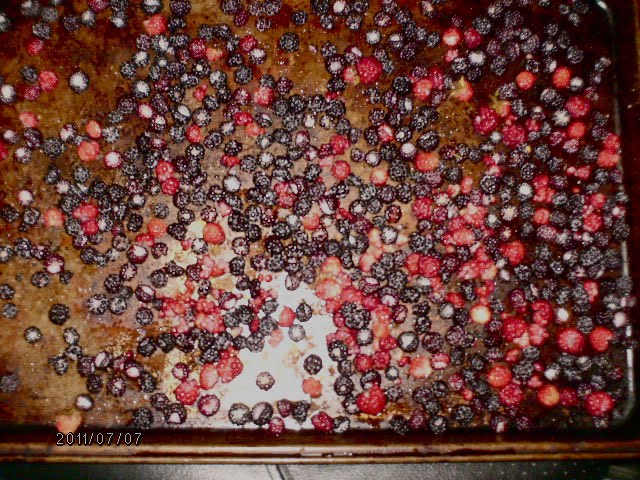
First Foraging Success of 2011


We went for a brief stroll today, just a jaunt before I had to go to work, and came away with all the berries you see to the left, as well as the promise of some very good grapes later in the season!

Tuesday, July 05, 2011

Ten Rules For the Self Sufficient Garden

Yesterday I picked up my second favorite magazine, "BackHome Magazine" and in it is an article that's really got me thinking. Without re-copying it word for word, I'll give you the gist of it and my thoughts.
(By the way, the video I promised has to wait until I can get some soil and time, but it IS coming, I promise)

Rule #1: Plant what you eat.
I'm planning on doing just that, but it has to wait until we get up north, because the only thing growing here with any great success is the herbs. (I doubt we'll get any tomatoes, but the apple tree is going gangbusters!) Our plans include growing apples, radishes, carrots, mesclun, cucumbers, cabbage, rye if I can get it to grow, potatoes, peas, broccoli, onions, zucchini, tomatoes, garlic, chives, peppers, tobacco, rhubarb, sweetgrass and sage, among others.

Rule #2: Plant what you can reliably grow under adverse conditions.
Key phrase here, "what you can reliably grow". well, that remains to be seen considering I'm not sure yet how bad the soil is up there.

Rule #3: Diversify
I think the above list shows a pretty wide diversification.

Rule #4: Preservation
We have extensive plans for preservation. Dehydrating, freezing, canning, powders (more about that later). I'd love a root cellar, but I don't think Mom & Dad would like it much.

Rule #5: Plant more than you think you'll need
With 6 or 7 mouths (depending on whether the Eldest Child moves with us) to feed, exactly how many pounds of potatoes does that work out to? How many tomatoes plants does that translate to? If I'm the only one who likes radishes, should I even bother? What about the aforementioned rye? Surely there must be some kind of chart on the web to answer these questions?

Rule #6: Save your own seed
It's one thing I'm trying to learn about now, while I still have all this time to read. I have at least learned how to save tomato seed successfully. I have visions of jars and envelopes lined up in the freeze, labelled carefully and waiting for soil.

Rule #7: Don't forget the specialty items.
For me, that means tobacco, sweetgrass and sage. These will be grown for spiritual reasons, for gifts and out of respect for the Native teachings we follow.

Rule #8: Stay organic
Because I have a sensitivity to pesticides, organic was my goal all the way along. I think I'm facing poor soil, so I've been learning all I can about green manure crops, compost and egg shells and coffee grounds in the soil, as well as the benefits of biochar. It also means I'll have to learn to distinguish between good bugs and bad. I know what a Colorado Potato Beetle looks like, and the Ladybug. But I've never seen a caterpillar with wasp eggs dotting it's back. Wonder if Chapters bookstore has a book on beneficial bugs?

Rule #9: Don't try to do it all in the first year.
That will be the tough part for me. I already have plans for a solar dehydrator, a solar oven and maybe even a cob oven, a mini greenhouse and a hoop house.

Rule #10: Time is your friend, not your enemy.
It takes time to learn some of the things that I want to learn, it's going to take time to improve that soil, time to build the preserve supply, the seed bank I want, and time to settle into home once more.

It's going to be a long year of waiting.

Saturday, July 02, 2011

Sweet Potatoes, Lettuce and Squirrels. Again.


I was cruising YouTube late last night when I came a cross a video in which a fella had started an indoor garden. Okay, not surprising you say, a lot of folks have done that. What caught my attention though is that he had melons growing. He had already gotten a crop of lettuce, and that got me energized to try again. So after long discussions with the best partner on the planet, I've decided to suck up my frustration and disappointment and try again. So tomorrow I'll be starting two buckets of sweet potatoes, rigged to keep out the squirrels, we'll be starting lettuce inside again, and carrots too.
I am still on the hunt for a grow-bulb to augment the one we already have, and I figure all I need to get is a couple of bags of potting soil and a bag of zoo poo.
I will get my helper to take pictures tomorrow as we go and provide regular updates as the tubers grow.

Thursday, June 30, 2011

Squirrel Thighs With Toasted Pine Nuts!

There's nothing like a reality check to bring a gardener down.
<----- That is what my carrots were supposed to look like.
There is nothing to show you now, the squirrels ate them. I went to work the day after my last post, pleased with how the plants were growing, and came home to an empty carrot planter.
I have spent the days since grinding my teeth at those little black-furred varmints. And coming up with squirrel dishes. Even at work yesterday I would randomly blurt out recipes to my boss, who knows why I'm resorting to such stress management tools. Squirrel stew, beer battered squirrel with home fried potatoes, squirrel and mushroom pie, squirrel hagis? (That one made even the Scottish boss turn a little green) My favorite was squirrel thighs in a pita with a side of toasted pine nuts. Ironic and fitting.

But now the question is, do I replant, and bring them inside when the weather turns nippy, or give up on carrots?

Sunday, June 26, 2011

How My Breakfast Feeds My Plants


Is it silly to be happy I got 2.5 cups of rainwater the other night?
This morning i have top dressed my tomato plants with a mixture of coffee grounds and crushed eggshells, and then watered it in with rainwater.
For me, this is big. The less water I have to use from the tap, the happier I am. Every ounce, every spoonful of extra TLC I can give my plants, the happier I am. So this one small act this morning made me feel that much closer to my plants, and my food.
The egg shells will boost the calcium in the soil, and help the tomatoes fight off end blossom rot, and the coffee grounds will help bring nitrogen. It seems likely these plants will never see my home-made compost, so any organic additive I can give them is good.

This year is all about learning and experimenting, and every time I do something like this, I feel a little closer to my goal.

Wednesday, June 22, 2011

The First "Wild" Onion of 2011

We visited an abandoned farm today that we've been keeping an eye on, since there's a few edibles there. I went only to check on the state of things after the rain, and in order to see how things were growing I pulled one up. Even though I'm a writer, I find it hard to express how it felt to be standing there with a dirty hand holding a gift from Mother Nature and the property's former owner. It was as if I heard a small voice whispering to my heart, 'There? See? THAT'S what your hands are meant to do!' I swear, I felt a piece of the universe fall into place. Here's the video.


Permaculture, Part 2

Produce No Waste:

By valuing and making use of all the resources available to us, nothing goes to waste.

On the land, on the farm, this is easy to understand. The animals consume and return to the eco-system in the form of their young, fiber, eggs, milk or meat. Along the way, their "waste" is composted and used to improve the soil. The compost enriches the fields and the crops enjoy heavier, healthier yields, to be consumed by both human and animal; once again coming full circle.
But in the city, this concept of "produce no waste" is a little more complex. We recycle. Magazines, newspapers, glass, plastic, office waste (including computers and assorted electronics), we can re-direct our rainwater, garden waste and kitchen trimmings are composted. Even urine can be used! Free nitrogen, anyone? I know of one heroic soul who doesn't use toilet paper. Now THAT'S reducing your waste!

So how do we reduce our waste even more? One idea is to pay attention to packaging. A friend and I had a discussion about this one day. She told me they were putting fewer bags out at the curb. Ever since, I've been wondering how my own family could produce less waste. We drink quite a bit of Coca-Cola, but much less now than we used to. I wonder which packaging harms the environment less, plastic bottles, or cans? Anyone know? We re-use our grocery bags (we have dogs), we use our backpacks when shopping and if we need more room than those provide, we always have 4 or 5 cloth bags with us. I have a few travel mugs to help me be a more responsible coffee drinker. But that begs the question...What do we do with the travel mugs when they are no longer usable? I have cups that leak and need replacing, are they recyclable? (Kudos to Tim Hortons for the .10 cent discount if you come in with any travel mug. Theirs or anyone elses) Even when we sit in, I use china mugs to go easy on the landfills.

I'm proud to say we compost, even though we live in an apartment. I get food grade buckets from Tim Hortons, so it was relatively easy to convert one into a compost tumbler. All one needs to do is drill a few holes in the bucket large enough for air to get in but small enough to keep stuff in and critters out. It's an interesting dance of 3 parts green matter to 1 part brown. Too much green and the compost-in-the-making will stink. Too much brown matter and it won't "cook", as I found out a few weeks ago. For those of you unfamiliar with composting, "green matter" is things like vegetable ends, peelings, cores, coffee grounds, tea bags and even the water the veggies are cooked in. My cold coffee goes in too unless I remember to water the tree with it. "Brown matter" in our neighborhood is the hay bale someone dumped down the road, last year's corn husks and leaves from the path beside the corn field. I make sure the composter lid is on tight and flip the bucket around a few times, roll it around a bit and take a peek to make sure it mixed thoroughly. yes, it's more work than just tossing it all out, but I know I'm giving back to the Earth. In the end, I'll have the greatest soil I've ever had, full of micro-nutrients that will give me happy plants and I'll know that I did my part to NOT clutter up our planet.

So enough from me, now it's your turn. What do you do to minimize waste?

Friday, June 17, 2011

The Mystery of Permaculture, Part 1

What is this permaculture I keep hearing about?

Permaculture: the development of agriculture ecosystems intended to be sustainable and self sufficient.

To clear it up even more, I dove further.

The ecological processes of plants, animals, their nutrient cycles, waste, climatic factors and weather cycles are all an integrated part of permaculture.
The output of one element becomes the input of another. Chicken manure gets composted to put back onto the land and improve soil. Garden trimmings, vegetable peelings and coffee grounds are also used in the same way. Viewed this way, work is minimized, "waste" is now a resource, productivity and yields increase and our environment is restored.

The first step, say the experts is observation. Wherever you want to put your garden, whether in the ground raised beds or a garden of pots and planters, watch the space for a few months first. A year is recommended. Take note of how much sun that space gets. Six hours or two? Full sun or dappled by a nearby tree? Is it in a breezeway or does it get no air movement at all? All of thee elements and more come into play. Observation also tells us what kind of soil there is in a neglected patch. White clover tells us that the soil lacks nitrogen, while the presence of dandelion, mullein and/or wild strawberries point to an acidic soil. Mullein alone is a good indicator of poor soil fertility. On the other hand, and extremely fertile soil will sprout red clover, chickweed and lamb's quarters.

Diversity is also integral to the permaculture system. Companion planting is beginner friendly, forgiving and easy to learn about. There's a wealth of information on the internet, in library books and at nurseries and even more reputable hardware stores that sell plants.
While you're still in the planning stage, think about the areas you'll be visiting most often and what plants you'll need more frequently. Obviously a balcony or patio garden has a different usage pattern than a yard, but bear with me for a minute longer. Herbs will likely be kept closer to the door. The less you use a plant, or animal, or waterer or any other part of your yard, the further from the door. The yard is segregated into zones to save steps, labour and make maximum use of the space available.

Another element is the capture and storage of energy. This can be demonstrated by the collection of rainwater, re-use of grey water, and even preserving your bounty by canning, freezing, or dehydrating. Those that have root cellars store their fruits and veggies using the earth, although there are folks out there that have turned spare rooms into "root cellars". Now before you tell me that onions and tomatoes are not a form of energy, think about it. Food gives us energy, therefore it IS energy. Solar power, hydro power, wind power,; all of these can be harnessed and stored.

Yet another part of permaculture is the value and use of renewable resources and services. A renewable resource might be a compost bin/bucket/pile. Waste goes in, soil additive comes out. Chickens, goats and rabbits are all renewable services. They all eat trimmings, the chickens love to forage for pests and in return contribute back to the overall system. Before you know it, you have more contribution in the forms of eggs, milk and fiber. They are renewable too! Chicks, kids and kits will grow to be the next generation of yard helpers, or meat, depending on how you feel about that sort of thing.

I've learned a lot more than these few basic principles, but it's too much for one post. Come back tomorrow and we'll talk about waste, integration, design, change and positive impacts.